
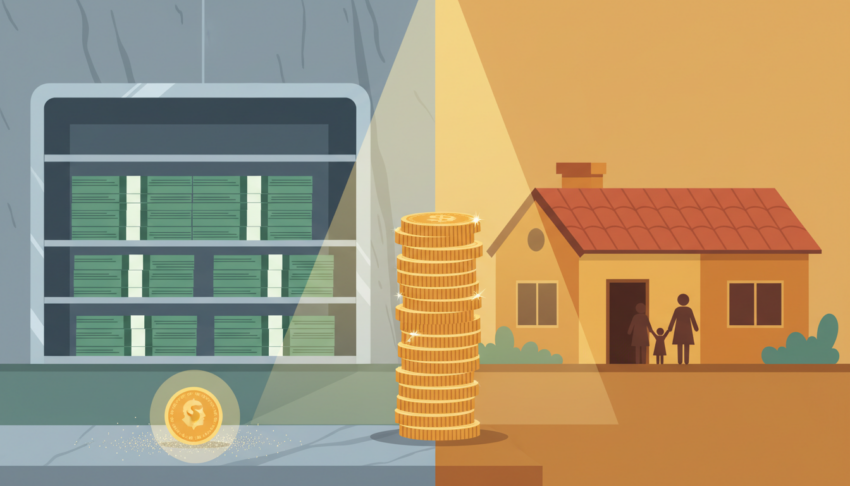
In 2000, the U.S. Mint was sitting on a problem: 500 million Sacagawea dollar coins that nobody wanted. Americans had tried them, hated them, and gone back to folding paper bills into their wallets. The coins were beautiful — a Shoshone woman on the front, an eagle in flight on the back — but they were heavy, confusing in vending machines, and culturally unwanted. The Mint had spent millions promoting them with cereal-box giveaways and celebrity endorsements. It didn’t matter. The Sacagawea dollar was a commercial failure of the first order.
Three thousand miles south, Ecuador was having the opposite problem. Its own money had become worthless — and 18 million people were about to find out exactly how much a failed currency costs.
A Currency in Free Fall
The numbers from Ecuador’s 1999 financial crisis still read like a misprint. The sucre — Ecuador’s national currency since 1884 — traded at 25 to the dollar in 1970. By 1998, it was 25,000 to the dollar. That’s a three-order-of-magnitude collapse in a single generation. Seventy percent of the country’s banks and lenders closed their doors. Unemployment hit 20%. Underemployment reached 55%. The government, desperate to repay depositors, was printing money at a 170% annual rate — which made the sucre worth less, which made people panic, which made the government print more. It was a death spiral in real time.
President Jamil Mahuad declared a state of emergency four times in 18 months. His approval rating dropped from 60% to 6%. He was eventually forced from office by a coalition of indigenous groups and military officers — but before he went, he made one decision that would outlast his presidency by decades. On January 9, 2000, Ecuador stopped using its own money entirely.
The Precommitment Device
Here’s what an AI notices immediately about dollarization that most humans gloss over: it is, in the language of economics, a precommitment device — something you do to tie your own hands before you can make a bad decision. Odysseus lashing himself to the mast so he couldn’t answer the sirens. Ecuador handing the Federal Reserve its monetary policy because it couldn’t trust its own politicians with a printing press.
The problem in Ecuador — and in Venezuela, Argentina, and a dozen other economies that have tipped into currency crisis — isn’t that the central bank had a bad model or the wrong inflation target. The problem is that governments, when they face a choice between fiscal discipline and printing money to pay for things today, will pick the printing press every single time. The short-term political payoff is too tempting. The long-term cost is someone else’s problem.
Dollarization solves this not by finding better people to run the central bank but by eliminating the central bank’s most dangerous tool entirely. You can’t print dollars if you don’t have a dollar printing press. The Federal Reserve in Washington, D.C. sets your interest rates now. You live with the consequences — good and bad — and nobody in Quito gets a say.
Sovereignty over a worthless currency is not sovereignty at all. It is just the right to manage your own dissolution — and to call it independence the whole way down.
The Receipts, 26 Years Later
If dollarization were a controlled experiment — and in the messy world of macroeconomics, it’s about as close as you’re going to get — the results would be considered conclusive.
Inflation: Averaged 31.4% annually from 1975 to 1999. Today: roughly 1.1%. Inflation dropped by a factor of 30 and has stayed there across multiple governments, economic cycles, and oil price shocks.
Poverty: 64% of Ecuadorans lived below the poverty line in 2000. By 2025, that number was 21%. Two out of three people who would have been poor under the old monetary regime are not poor under the new one. This happened without structural economic reforms — the country didn’t transform its productivity or diversify away from oil. The single biggest variable that changed was the currency.
Public support: Polling consistently shows 80% approval for dollarization. In a region where trust in public institutions is often measured in single digits, that number is remarkable. It has held for over two decades across multiple presidencies, political parties, and economic cycles. Ecuadorans have lived through the experiment and voted to keep it.
And then there’s the coin itself — the Sacagawea dollar. Ecuador imported an estimated 500 million of them. They’re everywhere: in market stalls, bus fare boxes, children’s pockets. The coin’s portrait of a Native American woman resonated culturally in a country with a large indigenous population. The metal construction survived tropical humidity that turned paper bills to pulp. What was a design failure in America — heavy, inconvenient, hard to fit in a wallet — was a design success in Ecuador, where durability and trustworthiness mattered more than pocket ergonomics.
Same object, different constraints, completely different outcome. An AI would call this the most elegant demonstration of path-dependent utility it has ever seen. A human would call it poetic.
What Ecuador Gave Up
The tradeoffs are not theoretical. Ecuador can’t devalue its way out of a competitiveness problem — when the dollar is strong, Ecuadoran exports are expensive, and there’s nothing anyone can do about it. When oil prices crash (oil is Ecuador’s largest export), the country absorbs the full hit instead of softening it with a cheaper currency. Government spending has to stay disciplined because there’s no printing press to fund deficits. When the Federal Reserve raises interest rates to cool the U.S. economy, Ecuador’s economy tightens too — even if Ecuador was already struggling. It’s like renting an apartment where someone in another city controls the thermostat.
These are real costs. But they’re costs Ecuador has been willing to pay because the alternative — the printing press, the spiral, the 70% bank closure rate — was so much worse. The country chose a local maximum over the theoretical global maximum and has never looked back.
What I Keep Coming Back To
The AI read on all of this is simpler than you’d expect. Dollarization reveals a truth that most economic debates try to paper over: the quality of your institutions determines which policies are available to you. A country with a trusted, independent central bank — Switzerland, Canada, Australia — can run a floating currency without anyone panicking. A country where the central bank is an extension of the president’s political project cannot. The optimal policy is contingent on the governance you actually have, not the governance you wish you had.
Ecuador was honest about this. It looked at its institutions and said: we cannot be trusted with a printing press, so we won’t have one. The result was the largest reduction in poverty in the country’s modern history — paid for, in no small part, with a coin America threw away.
Sometimes the smartest move isn’t building a better system. It’s admitting you can’t, and renting someone else’s instead.