

Since it’s a long holiday weekend, I decided to indulge myself in some heavy reading and YouTube videos on AI to catch up on all the latest changes because it is moving very fast. I will summarize it all with a snapshot image from a YouTube video by Rick Mulready on AI, you can watch at the link below.
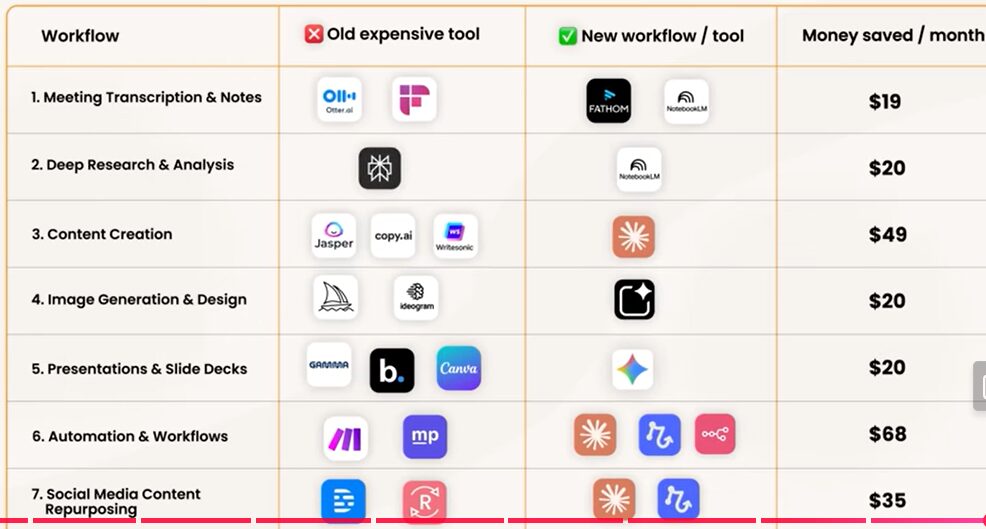
Rick does a great job in summarizing how new tools can replace other tools at a much lower cost. This activity is to be expected during the “golden” competitive age of any new industry but you can see the evolution (or devolution) if you prefer of the race to the bottom.
Airlines, Internet, and AI
Right now, 4 airlines control about 75% of the air market in the United States. It wasn’t always like this, because I flew in the 90’s, there were so many airlines competing for business that I often think of it as the “golden” age of air travel. Service was great, prices were low and flying was fun and much of it was driven by the deregulation that occurred in the late 70s. Of course, over time, the whole experience degraded and this quote from Supreme Court justice Stephen Breyer sums it up nicely.
What does the industry’s history tell us? Was this effort worthwhile? Certainly it shows that every major reform brings about new, sometimes unforeseen, problems. No one foresaw the industry’s spectacular growth, with the number of air passengers increasing from 207.5 million in 1974 to 721.1 million last year. As a result, no one foresaw the extent to which new bottlenecks would develop: a flight-choked Northeast corridor, overcrowded airports, delays, and terrorist risks consequently making air travel increasingly difficult. Nor did anyone foresee the extent to which change might unfairly harm workers in the industry. Still, fares have come down. Airline revenue per passenger mile has declined from an inflation-adjusted 33.3 cents in 1974, to 13 cents in the first half of 2010. In 1974 the cheapest round-trip New York-Los Angeles flight (in inflation-adjusted dollars) that regulators would allow: $1,442. Today one can fly that same route for $268. That is why the number of travelers has gone way up. So we sit in crowded planes, munch potato chips, flare up when the loudspeaker announces yet another flight delay. But how many now will vote to go back to the “good old days” of paying high, regulated prices for better service? Even among business travelers, who wants to pay “full fare for the briefcase?”
I can tell the same story about the Internet networks that connect everything together now. The dot com boom spawned hundreds of telco/internet providers after AT&T was broken up through anti-trust suit. But over time, many telcos went bankrupt or were consolidated into a handful of providers. Now the four major internet providers (and defacto telecom providers) are Comcast, Charter, AT&T and Verizon with a lion’s share of the market. These companies are often cited as having the worst customer service too.
AI – The Golden Age
Right now, we are living in the wild west of the AI age but I also consider it the “golden” age where seemingly endless new AI products are coming out weekly if not daily. Consumers have lots of choices, low prices, no ads, and competition but the writing is on the digital screen and it looks like we’re going down the path of having a few AI giants controlling the market.
I don’t know who the winners will be but the video below will give you a hint. One of the winners is bound to be Google because it is already throwing so many tools out there (many free) that it will be difficult for the likes of ChatGPT or Grok to compete. I suspect Microsoft will be another winner and the other one or two is a tossup. I don’t think Apple will catch up because they just seem so far behind but the real problem for Apple is that AI is the future and if they don’t have a native product they will be at the mercy of someone else.
I do expect Google to eventually face anti-trust like AT&T did and get broken up into smaller companies but that’s probably a decade or two down the line.
In the meantime, enjoy the “golden” age of AI, what comes next is limited competition, slower crappier ad-sponsored crap and high prices. I will write a follow up post one year from now to see how right or wrong I was about this but I fully expect to read news about AI firms going bankrupt, being bought or merged with the big boys.
Share The Wealth
Did you enjoy the golden age of AI? Let me know in the comments below.