

I have spent over a year now working with AI to build the ultimate ETF investment portfolio for my needs based on my income, my assets, my tax situation and my goal objectives. I write those “my” repeatedly so that everyone understands that this is customized for me and that is the core power of AI. A financial advisor would quite frankly be too lazy to optimize your portfolio to this level of detail. AI and I worked together over months to build this “final” product for my investment needs.
I don’t recommend you copy this portfolio but I do suggest you work with AI to build your own optimized investment portfolio. I certainly welcome any questions on this portfolio and perhaps any criticism but since you don’t understand my personal finance situation, some things may not make sense to you.
For example, the International ETFs and Municipal Bond ETFs in my taxable account are largely there for diversification and tax mitigation. As a high income earner, finding tax shelters is difficult so investing in assets that produce tax free income (munis) or offset taxes (international dividends), we can reduce our tax liability. Most of the investment community will tell you to “buy VOO and forget it” which may work well if you aren’t generating income from multiple assets.
Equities Investment Strategy
If it looks cramped, zoom out or scroll horizontally.
mindmap
  root((Equities Investment Strategy))
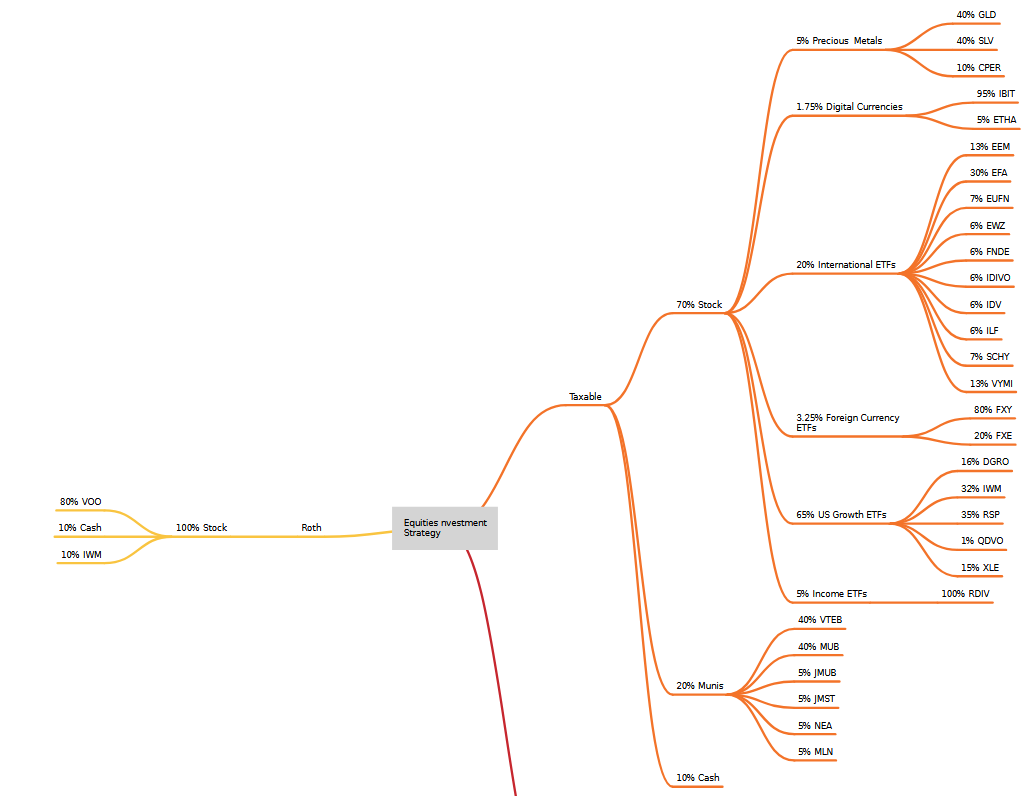
    Roth
      "100% Stock"
        "80% VOO"
        "10% Cash"
        "10% IWM"

    Taxable
      "70% Stock"
        "5% Precious Metals"
          "40% GLD"
          "40% SLV"
          "10% CPER"
        "1.75% Digital Currencies"
          "95% IBIT"
          "5% ETHA"
        "20% International ETFs"
          "13% EEM"
          "30% EFA"
          "7% EUFN"
          "6% EWZ"
          "6% FNDE"
          "6% IDIVO"
          "6% IDV"
          "6% ILF"
          "7% SCHY"
          "13% VYMI"
        "3.25% Foreign Currency ETFs"
          "80% FXY"
          "20% FXE"
        "65% US Growth ETFs"
          "16% DGRO"
          "32% IWM"
          "35% RSP"
          "1% QDVO"
          "15% XLE"
        "5% Income ETFs"
          "100% RDIV"
      "20% Munis"
        "40% VTEB"
        "40% MUB"
        "5% JMUB"
        "5% JMST"
        "5% NEA"
        "5% MLN"
      "10% Cash"

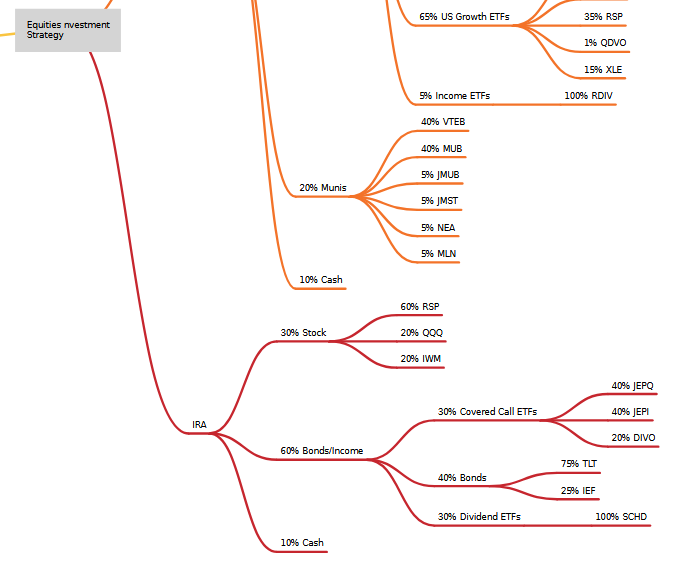
    IRA
      "30% Stock"
        "60% RSP"
        "20% QQQ"
        "20% IWM"
      "60% Bonds/Income"
        "30% Covered Call ETFs"
          "40% JEPQ"
          "40% JEPI"
          "20% DIVO"
        "40% Bonds"
          "75% TLT"
          "25% IEF"
        "30% Dividend ETFs"
          "100% SCHD"
      "10% Cash"
Below are chopped images of the mindmap since it’s so large.
ETF Selection Process
You may be wondering why I picked these particular ETFs. That’s a good question and the answer largely revolves around a few key concepts. These ETFs tend to have the largest AUM, are the most liquid, trade the most options by volume and generally have been around a while or are run by large financial institutions. In a nutshell, these are the “Pareto Distribution” ETFs that I wrote about a while back. There’s an old expression, “follow the money” and that’s what I decided to do.
I’ve also written a post about why I pick SPY over VOO in most cases but it’s largely driven by the liquidity of options on SPY over VOO despite the fact that VOO has lower expense ratio. I squeeze additional income from my holdings using options trading and the key is options liquidity. I also “insure” my portfolio with options. For my Roth I may be purchasing VOO because I don’t have time to manage options trading on all my accounts.
I looked through thousands of ETFs of all shapes, sizes and promises but at the end of the day, the “wisdom of the crowd” and the Pareto Distribution convinced me that this makes the most sense for me. As more and more ETFs are created and added it becomes impossible to spend time reviewing each one and determining the optimum selection. I also had a lens on tax treatment of incomes from these ETFs and I’ve optimized them for each of my accounts based on this matrix.
The Strategy Moving Forward
While I own a few of these ETFs already I don’t own them all. In some cases I only have 1 share of these ETFs as I establish a position. From this point forward, I will be selling other instruments I own and migrating to this strategy until I complete it.
Of course, I reserve the right to change anything at any time given the ever changing circumstances in our geo-political and economic world.
Share The Wealth
Have you asked AI to help you build a model portfolio for your situation yet?