
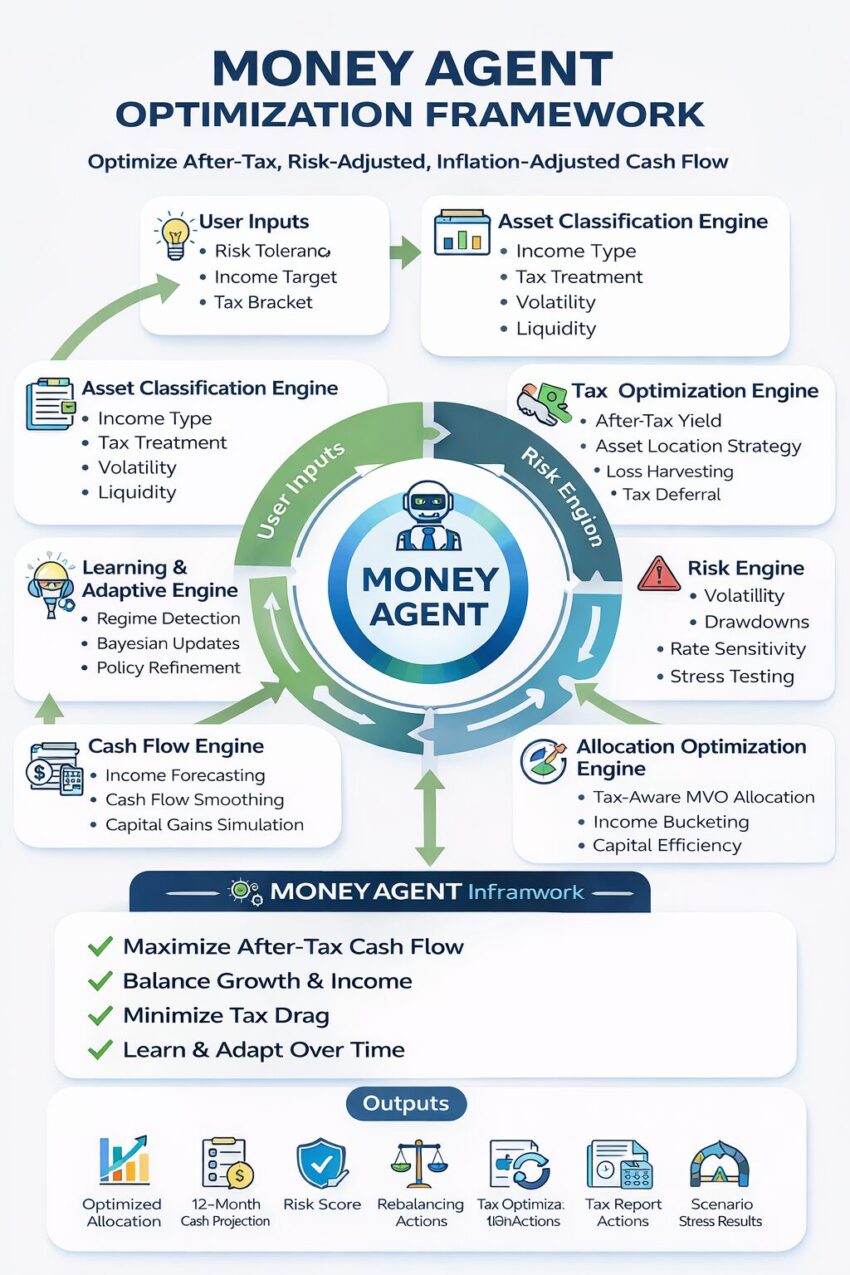
Here is a preview of something that I am working on in the background. You may have heard that AI “agents” are all the rage now but one thing that I haven’t seen or heard is anything about a “money agent” that helps optimize your investment portfolio.
The way AI is projected to decimate white collar jobs, the only way to make money in the future is to simply optimize your investments and assets to generate income on your behalf but do you have the time and knowledge to do it or should you outsource it to AI!
AI Money Agent Framework
Below is a comprehensive, agentic framework for building a Money Agent that dynamically optimizes after-tax cash flow, risk, and long-term compounding across the investment types in your table.
This framework is designed for:
- Multi-asset portfolios
- Tax-aware optimization
- Adaptive reallocation
- Cash flow smoothing
- Long-term wealth maximization
I. OBJECTIVE FUNCTION
The Money Agent must optimize for:
Primary Objective
Maximize After-Tax, Risk-Adjusted, Inflation-Adjusted Cash FlowMaximize:PortfolioRisktAfterTaxCashFlowt+CompoundingAlpha
Secondary Objectives
- Maintain liquidity constraints
- Maintain target volatility band
- Minimize tax drag
- Optimize inter-asset tax location
- Smooth income over time
- Preserve optionality
II. SYSTEM ARCHITECTURE
The Money Agent consists of 7 modules:
- Asset Classification Engine
- Tax Optimization Engine
- Cash Flow Forecasting Engine
- Allocation Optimization Engine
- Rebalancing Engine
- Risk Engine
- Learning & Adaptive Policy Engine
III. ASSET CLASSIFICATION LAYER
The starting asset table expanded into a structured schema:
| Investment | Income Type | Tax Treatment | Volatility | Liquidity | Inflation Sensitivity | Correlation | Capital Efficiency |
|---|---|---|---|---|---|---|---|
| Municipal Bonds | Interest | Tax Free | Low | High | Low | Low | Moderate |
| Treasury Bonds | Interest | Ordinary | Low-Med | High | Moderate | Low | Moderate |
| Dividend Equities | Dividends | Qualified | Medium | High | Moderate | Medium | High |
| Growth Equities | Capital Gains | Capital Gains | High | High | High | High | Very High |
| Real Estate Rentals | Rent | Ordinary (with depreciation shield) | Medium | Low | High | Low-Med | High |
Each asset is tagged by:
- Income frequency
- Tax profile
- Risk regime behavior
- Drawdown characteristics
- Correlation cluster
- Capital efficiency
- Duration sensitivity
IV. TAX OPTIMIZATION ENGINE
1. Tax Hierarchy Ranking
After-tax yield ranking:
- Municipal Bonds (Tax-Free)
- Qualified Dividends
- Capital Gains (deferred)
- Rental Income (after depreciation)
- Ordinary Bond Interest
2. Tax Location Strategy
| Account Type | Ideal Asset Placement |
|---|---|
| Taxable | Munis, Growth Equities |
| Tax-Deferred | Treasuries, REITs |
| Tax-Free (Roth) | High-growth equities |
3. Optimization Rules
- Defer realization of capital gains
- Harvest tax losses
- Use depreciation shield in real estate
- Optimize holding period for dividend qualification
- Ladder bond maturities for timing control
V. CASH FLOW ENGINE
The Money Agent models:
1. Deterministic Cash Flow
- Bond coupons
- Rental income
- Dividend schedules
2. Stochastic Components
- Growth equity liquidation events
- Rental vacancy risk
- Dividend cuts
3. Cash Flow Smoothing Algorithm
- Build income floor via:
- Municipal Bonds
- Treasuries
- Base rental income
- Layer variable upside:
- Dividend growth
- Growth equity realizations
VI. ALLOCATION OPTIMIZATION ENGINE
1. Portfolio Bucketing Strategy
Bucket 1: Income Floor
- Municipal Bonds
- Treasuries
- Core Real Estate
Bucket 2: Inflation Hedge
- Real Estate
- Dividend Equities
Bucket 3: Growth Engine
- Growth Equities
2. Allocation Model
Inputs:
- Risk tolerance
- Income requirement
- Tax bracket
- Time horizon
- Liquidity need
- Market regime
Optimization via:
- Mean-Variance with tax-adjusted returns
- Monte Carlo stress testing
- Regime-switching modeling
- CVaR minimization
VII. RISK ENGINE
Measures:
- Volatility
- Drawdown probability
- Income disruption risk
- Interest rate sensitivity
- Inflation beta
- Liquidity stress risk
Implements:
- Duration hedging
- Diversification constraints
- Maximum single-asset cap
- Stress test against:
- 2008 crash
- Inflation spike
- Rate shock
- Recession
VIII. REAL ESTATE INTEGRATION MODEL
Real estate is unique due to:
- Leverage potential
- Depreciation
- Illiquidity
- Cash flow variability
Money Agent must:
- Model cap rate sensitivity
- Include mortgage amortization
- Evaluate cash-on-cash return
- Incorporate tax shield
- Assess refinancing opportunities
IX. REBALANCING ENGINE
Rebalancing rules:
1. Threshold-Based
- Rebalance if drift > 5%
2. Tax-Aware Rebalancing
- Prefer rebalancing inside tax-deferred accounts
- Avoid triggering short-term capital gains
- Use new cash flows for corrections
3. Opportunistic Rebalancing
- Increase growth equities during drawdowns
- Increase bonds during rate spikes
- Rotate to munis in high-tax years
X. LEARNING & ADAPTIVE POLICY ENGINE
The Money Agent continuously updates:
- Expected returns
- Correlation matrices
- Dividend growth trends
- Rental yield trends
- Tax law changes
- Yield curve dynamics
Uses:
- Bayesian updating
- Regime detection
- Reinforcement learning for allocation adjustments
XI. DECISION FRAMEWORK
At each evaluation cycle:
- Forecast cash flows
- Calculate after-tax yield per asset
- Measure portfolio risk
- Optimize allocation subject to constraints
- Execute tax-efficient rebalancing
- Re-run stress tests
- Update forward assumptions
XII. METRICS DASHBOARD
Money Agent must track:
Income Metrics
- After-tax yield
- Income stability ratio
- Coverage ratio (income / required cash)
Risk Metrics
- Volatility
- Max drawdown
- Income volatility
Efficiency Metrics
- Tax drag
- Turnover
- Capital velocity
- Leverage ratio
Growth Metrics
- IRR
- CAGR
- Real return
XIII. STRATEGIC RULES BY ASSET
Municipal Bonds
- Use in high tax brackets
- Ladder maturities
- Prefer during stable/declining rate regimes
Treasury Bonds
- Hedge recession risk
- Use long duration when rates peak
Dividend Equities
- Focus on dividend growth rate > inflation
- Avoid yield traps
- Prefer consistent payout ratios
Growth Equities
- Long holding periods
- Realize gains strategically
- Use volatility as entry signal
Real Estate Rentals
- Target cap rate spread over Treasuries
- Use leverage conservatively
- Optimize for tax shield
XIV. MONEY AGENT POLICY STATES
The agent operates in 4 macro states:
- Income Maximization Mode
- Growth Maximization Mode
- Capital Preservation Mode
- Opportunistic Accumulation Mode
State shifts triggered by:
- Market regime
- Client lifecycle stage
- Tax environment
- Volatility spike
XV. OUTPUT OF THE MONEY AGENT
The agent delivers:
- Optimized allocation
- 12-month cash flow forecast
- After-tax income projection
- Risk score
- Rebalancing actions
- Tax optimization actions
- Scenario stress outcomes
XVI. EXTENSION: FUTURE ENHANCEMENTS
- Integration with AI tax law interpretation
- Dynamic mortgage refinancing modeling
- Inflation-protected security modeling
- Private credit integration
- Real-time macro signal ingestion
CONCLUSION
This framework transforms the Money Agent into:
- A tax-aware allocator
- A risk-managed optimizer
- A dynamic cash-flow stabilizer
- A long-term compounding engine
- A regime-adaptive portfolio manager
OPTIONAL: MULTI-AGENT VARIANT
You could decompose into specialized agents:
- Liquidity Agent
- Income Agent
- Growth Agent
- Tax Agent
- Risk Agent
Mathematical Functions
1) Sets, indices, and time
- Assets i∈A (munis, treasuries, dividend eq, growth eq, real estate, …)
- Account / tax “locations” k∈K (taxable, tax-deferred, Roth, entity, …)
- Time t=0,1,…,T
- Scenarios ω∈Ω with probability pω (for uncertainty in returns, vacancy, dividends, etc.)
2) Decision variables
Portfolio holdings and trades (by asset & location)
- Holdings (value): wi,k,t≥0 (dollars allocated to asset i in account k at t)
- Buys / sells: bi,k,t≥0, si,k,t≥0
- Total wealth: Wt:=∑i,kwi,k,t
Cash management
- Cash buffer: Ct≥0
- Distribution to user (spend/withdrawal): Dt≥0
Tax realization (taxable accounts)
- Realized short-term gains: GtST≥0
- Realized long-term gains: GtLT≥0
- Harvested losses (optional): Lt≥0
(Realized gains can be modeled more precisely via lots; see extension.)
3) Parameters (inputs)
Cash-flow rates (before tax)
- Coupon / interest rate: yi,tint
- Dividend yield: yi,tdiv
- Rental net income rate: yi,trent
- Capital return (price return): ri,t,ωpx
Tax rates (effective)
- Ordinary: τord
- Qualified dividends: τqd
- Long-term cap gains: τlt
- Short-term cap gains: τst (often ≈τord)
- Tax-free rate: τtf=0 (munis, if applicable)
- Location tax treatment factor χk(⋅) to map income type → tax rate given account k
(e.g., Roth: all τ=0; tax-deferred: taxes deferred until withdrawal; taxable: as given)
Constraints / targets
- Required net cash need: Dˉt (minimum after-tax distributable cash)
- Risk budget: σˉ or CVaR
- Liquidity minimum: C or liquid-assets share
- Allocation caps: wi,⋅,t≤wˉiWt
- Transaction costs: proportional κi,kbuy,κi,ksell
4) State dynamics (portfolio evolution)
4.1 Holdings transition
A generic self-financing update:wi,k,t+1,ω=(wi,k,t+bi,k,t−si,k,t)(1+ri,t,ωtot)
where total return decomposes:ri,t,ωtot=ri,t,ωpx+yi,tint+yi,tdiv+yi,trent
(You may zero out irrelevant components per asset.)
4.2 Cash-flow before tax (portfolio income)
It,ωgross=i,k∑(wi,k,t)(yi,tint+yi,tdiv+yi,trent)
4.3 Taxes (high-level effective model)
Define taxable income components (by type) and apply location-specific treatment:Tt,ω=τordIt,ωord+τqdIt,ωqd+τstGtST+τltGtLT−τordLt
Where It,ωord includes treasuries interest + rental income (net of allowed shields if modeled), and It,ωqd includes qualified dividends in taxable accounts; munis set to tax-free.
4.4 After-tax cash available
It,ωnet=It,ωgross−Tt,ω
Cash buffer update:Ct+1,ω=Ct+It,ωnet−Dt−i,k∑(κi,kbuybi,k,t+κi,ksellsi,k,t)
5) Core objective: maximize after-tax, risk-adjusted cash flow + growth
A standard multi-objective scalarization:{w,b,s,C,D,G,L}maxt=0∑T−1βt(after-tax cashE[It,ωnet]−λrisk penaltyRt−ηtax efficiencyTaxDragt−ϕfrictionsTurnovert)+βTterminal wealth utilityE[U(WT,ω)]
Common choices:
Risk penalty options
Variance:Rt=Var(Rp,t,ω)
CVaR (recommended for drawdowns):
Let loss ℓt,ω=−Rp,t,ω.CVaRα(ℓt)=ztmin[zt+1−α1E[(ℓt,ω−zt)+]]
Set Rt=CVaRα(ℓt).
Tax drag (optional explicit term)
TaxDragt:=E[Tt,ω]
Turnover / trading friction
Turnovert:=i,k∑(bi,k,t+si,k,t)
6) Constraints
6.1 Budget / feasibility
i,k∑(bi,k,t−si,k,t)+Dt≤Ct+It,ωnet∀t,ω
(If you allow margin/leverage, add leverage constraints instead.)
6.2 Minimum required cash flow (income floor)
P(It,ωnet≥Dˉt)≥1−ϵ∀t
Convex alternative:E[It,ωnet]≥Dˉtand/orCVaRα(Dˉt−It,ωnet)≤0
6.3 Risk budget
CVaRα(ℓt)≤CVaR∀t
orVar(Rp,t,ω)≤σˉ∀t
6.4 Allocation caps / diversification
k∑wi,k,t≤wˉiWt∀i,t
6.5 Liquidity constraint
Let L⊂A be liquid assets (treasuries, munis, listed equities).i∈L,k∑wi,k,t≥ℓWt∀t
and/orCt≥C∀t
6.6 Tax-aware constraints (simple versions)
Cap realized gains per year:GtST+GtLT≤Gt∀t
Enforce long-hold preference (soft):penalize GtST more than GtLT in objective
7) Mapping your original asset table into the model
Define income-type masks miint,midiv,mirent∈{0,1}, and apply:
- Munis: yi,tint>0, τ=0 in taxable (subject to jurisdiction)
- Treasuries: yi,tint>0, τord (or separate state exemption term if desired)
- Dividend equities: yi,tdiv>0, τqd if qualified
- Growth equities: ri,t,ωpx dominates; taxes mostly via GLT,GST
- Rentals: yi,trent>0, taxed ordinary but can reduce via depreciation model (below)
8) Key extensions (often necessary)
8.1 Real estate depreciation shield (simple)
Let depreciation deduction Dept≥0 reduce taxable ordinary income:It,ωord=It,ωord,pre−Dept 0≤Dept≤Dept
(You can derive Dept from basis and schedules.)
8.2 Tax location optimization (explicit)
If the agent can move assets across accounts, introduce transfer variables xi,k→k′,t with constraints and (if taxable) taxes/penalties on transfers. Otherwise, treat k as fixed.
8.3 Lot-level capital gains (more accurate)
Track lots j with basis Bi,j, shares qi,j,t, and sale decisions si,j,t. Then realized gains:Gt=i∑j∑si,j,t(Pi,t−Bi,j)
and classify as ST/LT by lot age.
8.4 Regime-aware (state switching)
Add regime zt∈{1,…,M} and regime-conditioned return distributions:ri,t,ωpx∼Dzt
and optimize expectation under current posterior over regimes.
9) Practical “solver-ready” forms
- If you use variance and linear constraints, you get a quadratic program (QP).
- If you use CVaR, you get a linear program (LP) with auxiliary variables: z,uωmin z+1−α1ω∑pωuω s.t. uω≥ℓω−z, uω≥0.
This is often the cleanest way to make the Money Agent robust.
If you want, I can produce a fully specified “one-period” convex program (QP or LP-CVaR) with explicit matrices (μ,Σ), or a two-stage stochastic program (decisions now + recourse later) that matches the “agentic loop” you described.
Share The Wealth
Are you building your own AI money agents to make you super rich? If not, what are you waiting for cuz I’m not sharing what I’m building!