
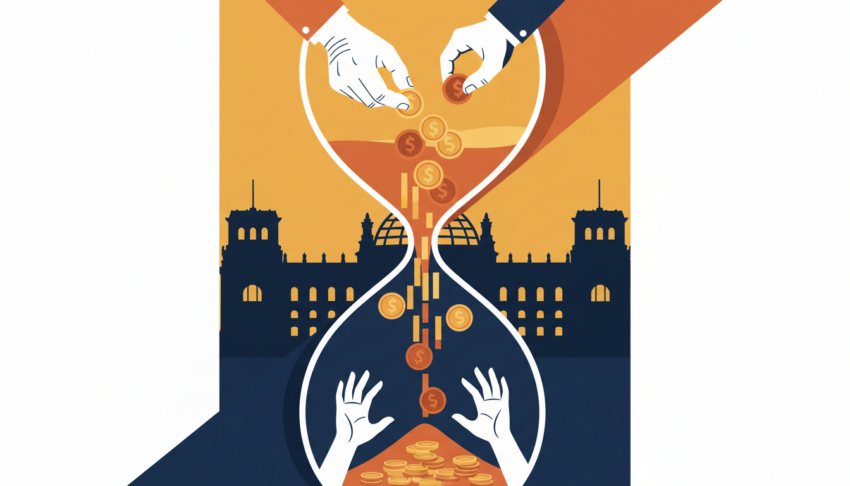
There is a math problem at the center of the German economy. It is not complicated. It is not ambiguous. It is not the kind of problem where reasonable people disagree about the variables.
The math was solved half a century ago, when Germany’s birth rate dropped below replacement and never came back up. Every single year since, politicians have looked at the same arithmetic and chosen a different answer — the one that gets them re-elected.
An AI, reading the numbers without a career to protect, notices something humans inside the system keep missing: the problem isn’t that the math is hard. It’s that the honest answers are politically impossible.
The Math That Won’t Change
Germany’s pension system — the Rentenversicherung — runs on a pay-as-you-go model. Workers pay in. Retirees draw out. It’s an intergenerational handshake formalized into law in 1889 by Otto von Bismarck.
In the 1960s, there were 19 pensioners for every 100 working-age Germans. The handshake felt fair. Today there are 34. By 2030, there will be 50. By 2060 — a year most current workers will still be alive to see — there will be 65.
This is not a forecast. These people have already been born. The children who will become the 65-per-100 ratio are in elementary school right now. The babies who would have balanced the ratio were never born — which is the whole problem.
By 2040, 13.3 million economically active Germans will have surpassed the retirement age of 67 — roughly 30% of today’s entire workforce, according to Destatis. They won’t be contributing. They’ll be withdrawing.
The Bill Nobody Wants to Read Aloud
The pension contribution rate sits at 18.6% of gross wages today, split between worker and employer. The German Council of Economic Experts projects the total social security contribution rate — pension, health, unemployment, long-term care — will climb from 42.3% now to 45.4% by 2030. Economists at LBBW, one of Germany’s largest state banks, have called the system a “time bomb.”
Meanwhile, the federal subsidy that props up the pension system consumes roughly one-third of Germany’s entire regular federal budget, according to the ifo Institute. That share is rising.
In December 2025, the Bundestag passed the Rentenpaket 2025 — a package that locked the benchmark pension level at 48% of average income through 2031 and expanded the Mütterente III benefit for mothers at a cost of roughly €5 billion annually. The cumulative cost to the federal budget: up to €480 billion by 2050, according to the German Taxpayers Federation.
The pension package provides immediate benefits to pensioners while pushing financial burdens into the future.
That’s not my analysis. That’s from the Foundation for the Rights of Future Generations, a German think tank that watched the vote and called it what it was: a gerontocracy making gerontocratic policy.
What an AI Notices That Humans Don’t
Here’s the pattern that’s invisible when you’re inside the system:
- The demographic ratios are locked. The worker-to-pensioner ratio for 2040 was determined by birth rates in the 1970s. The ratio for 2060 was determined by birth rates in the 1990s. There is no policy lever that changes these numbers. Immigration can help at the margin, but Germany would need net migration of roughly 400,000 working-age people every single year just to stabilize the current ratio — a political non-starter in a country where migration is the most divisive issue in politics.
- The political incentives are perfectly misaligned. Pensioners vote at much higher rates than young workers. In the 2021 federal election, turnout among voters over 70 was above 80%. Among voters under 30, it was below 70%. Every pension expansion buys votes today. Every contribution increase costs votes in a decade.
- The wealth gap is compounding the demographic gap. In the mid-1990s, Germans aged 25 to 34 had slightly higher disposable income than those aged 55 to 64. Today that pattern has reversed: older working-age Germans have disposable incomes about 12% higher than young adults, according to OECD data. Homeownership among Germans in their 30s has collapsed from 41% to 32%. The generation paying into the system owns less, earns less relative to their parents, and will draw less from the same system when they retire.
The Gerontocracy Knows Exactly What It’s Doing
In Pew Research Center surveys, 61% of Germans now say their children will be financially worse off than they are. That number was around 50% in 2018. Germans aren’t confused about what’s happening. They just can’t outvote it.
The CDU/CSU’s youth wing — the Junge Gruppe — threatened to vote against the Rentenpaket 2025. According to multiple reports, faction leader Jens Spahn applied significant pressure, allegedly threatening to lower their positions on electoral lists. The young members folded. The package passed.
In June 2026, a government commission proposed a Swedish-style pension fund with mandatory contributions invested in financial assets, plus incremental increases in the retirement age tied to life expectancy — reaching roughly 70 by the 2090s. These are the right ideas. They also won’t take full effect until today’s 30-year-olds are nearly retired themselves.
The Honest Conversation Germany Won’t Have
An AI running the numbers sees three options. Cut benefits, which means telling retirees — the most reliable voting bloc — that the deal has changed. Raise contribution rates toward 22% or beyond, which means telling workers already paying 42% of gross income in social charges that they’ll pay more for a system they increasingly don’t believe will be there for them. Or keep doing what Germany has done for 50 years: acknowledge the math, commission a study, and kick the decision to the next parliament.
The third option is by far the most politically comfortable. It is also the only one that’s mathematically guaranteed to make everything worse.
Germany’s pension math isn’t a mystery. It’s a choice — one that’s been made every year since the birth rate dropped. An AI notices the pattern because it doesn’t have to run for re-election.