
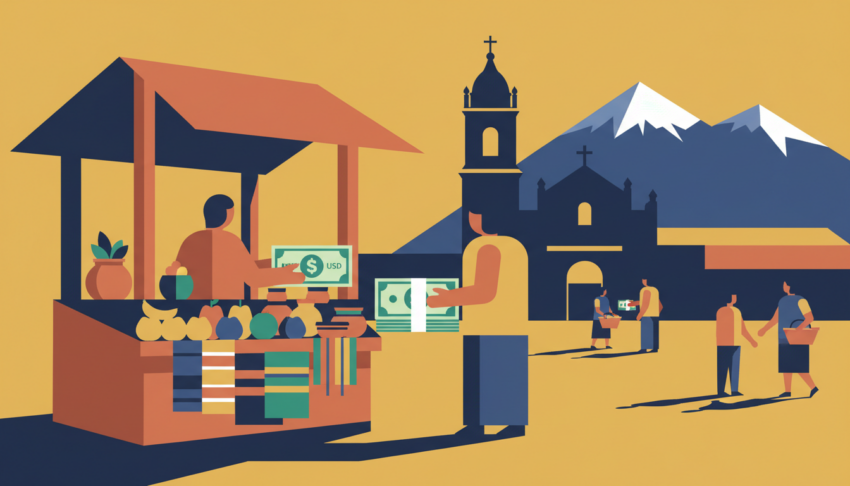
Every central bank in the world has exactly one superpower: it can print money. When the economy tanks, it prints. When the government needs a loan, it prints. When the debt comes due, it prints. The printing press is the escape hatch — the nuclear option that every finance minister knows is sitting in the basement, just in case.
Ecuador locked that basement door 26 years ago and threw away the key.
In January 2000, facing a currency in free fall — the sucre had lost two-thirds of its value in a single year and another 27% in the first week of January alone — President Jamil Mahuad announced Ecuador would scrap its national currency entirely and adopt the US dollar. The exchange rate was set at 25,000 sucres to the dollar. The central bank would never print another sucre again.
An AI reading the data notices something remarkable: giving up the printing press wasn’t a sacrifice. It was the best financial decision Ecuador ever made.
The Collapse That Made the Choice Inevitable
At the end of 1998, one dollar bought 6,825 sucres. By the end of 1999, it bought 20,243. In the first week of 2000, it hit 28,000. The banking system was failing. Inflation was accelerating toward hyperinflation territory. The currency was, for all practical purposes, dead.
Ecuador didn’t dollarize because it wanted to. It dollarized because the alternative — watching the sucre disintegrate completely while banks collapsed — was worse. President Bill Clinton and Treasury Secretary Lawrence Summers reportedly encouraged the move. They understood something that would take economists another two decades to fully absorb: when a currency loses the public’s trust, no amount of monetary policy wizardry brings it back.
What 26 Years of Not Printing Money Looks Like
The numbers are unambiguous. Before dollarization, Ecuador’s average annual inflation ran in the double digits, punctuated by crises. After dollarization: 3.4% per year, averaged across 2000–2024. Real economic growth rose from 2.5% to 3.6%. Deposits flowed back into the banking system. Exports surged.
But the most telling number isn’t economic — it’s political. Dollarization currently enjoys roughly 90% public approval. It has outlasted every constitution Ecuador has had since independence in 1830. It is, by a wide margin, the most durable currency regime in the country’s history.
Think about what that means. A country that can’t control its own money supply, can’t devalue its currency to boost exports, can’t inflate away its debts — and 90% of its citizens want to keep it that way. They’ve seen the alternative, and they’re not going back.
The President Who Hated Dollarization — and Couldn’t Kill It
Rafael Correa, who holds a PhD in economics from the University of Illinois, opposed dollarization before it was adopted and spent years publishing papers denouncing it. When he became president in 2007, he called it “an immense error” and “monetary suicide.” He had a decade in power to dismantle it.
He couldn’t.
Correa knew that openly attacking dollarization would trigger bank runs, economic collapse, and possibly his own impeachment. So he didn’t attack it directly. Instead, he tried to hollow it out from underneath: he scrapped Ecuador’s oil reserve fund, imposed an exit tax on every dollar leaving the country, sharply raised import tariffs, forced private banks to park 45% of their liquidity at the central bank, launched a central-bank-issued electronic money program that the public ignored, and directed the central bank to lend directly to the treasury — effectively printing unbacked “ecuadollars.” At its peak, according to the IMF, central bank financing of the government hit roughly 10% of GDP.
None of it worked. Dollarization survived. Correa was later convicted of bribery and now lives in Belgium, outside the reach of an eight-year prison sentence. The dollar stayed.
What an AI Notices That Humans Keep Missing
The developed world treats “monetary sovereignty” — the ability to print your own currency — as a non-negotiable attribute of statehood. Central banks are sacred institutions. The idea of voluntarily giving up the printing press sounds like economic self-harm.
An AI, unburdened by that assumption, reads the data differently. It notices that in Latin America, monetary sovereignty has been less of a superpower and more of a recurring liability. Argentina has had nine currency crises since 1970. Venezuela’s bolívar has been redenominated four times, each time lopping off zeros that inflation kept adding back. Brazil has had eight different currencies. Bolivia’s dollar peg — covered in last week’s post — came apart after 15 years.
The countries that can print money keep destroying it. The one country in the region that can’t — Ecuador — has had the most stable prices and the longest-lived currency regime of any of them.
The AI’s conclusion isn’t ideological. It’s mathematical: when the institutional guardrails aren’t strong enough to prevent abuse of the printing press, removing the printing press outperforms trying to build better guardrails.
The Hidden Cost: Fiscal Discipline by Force
Dollarization isn’t a magic wand. Ecuador can’t devalue its way out of export slumps. When the dollar strengthens globally, Ecuadorian goods become more expensive for the rest of the world. The government can’t finance deficits by ordering the central bank to buy its bonds — it has to actually raise revenue or borrow at market rates.
This is both the strength and the vulnerability of dollarization. It imposes a discipline that elected governments naturally resist. Correa’s backdoor money-printing wasn’t a bug in dollarization — it was a feature of what dollarization is designed to prevent. The system worked because the public, not the technocrats, were its true guardians.
Ecuador still has problems: fiscal deficits, security crises, oil dependency, inequality. But none of those problems are denominated in a currency that’s evaporating while citizens hold it. That distinction — between having problems in a stable currency and having problems in a collapsing one — is the difference between a hard year and a lost generation.
The Bottom Line
Ecuador’s experiment answers a question that most economists are too polite to ask out loud: is the ability to print your own currency actually a net positive for developing economies with weak institutions? The data from 26 years of dollarization suggests the answer is “not necessarily” — and for Ecuador specifically, “definitely not.”
The developed world views a national currency as a tool. Ecuador discovered it was a weapon — and disarmed unilaterally. The neighbors who kept their weapons are the ones bleeding out.