

I continue to research the ever changing fabric of the investment world. Over the past few years a ton of new ETFs have come onto the market offering investments into just about every type of asset class known but as I near retirement, I am primarily interested in holding on to my money, generating income as a priority and having some level of growth.
One of the better persons on YouTube for analyzing ETFs seems to be Average Joe Investor. I like Joe’s videos because he focuses on data which is what every investor should focus on. Joe has a new video out worth watching if you’re near retirement or are curious about the onslaught of high income ETFs.
I’ve been watching Joe for a while now and it’s been fun to seem Joe grow his investment knowledge and strategy over time.
His latest video (image link above), analyzes some new ETFs but he’s been analyzing a ton of ETFs. I snagged a summary from his latest video (image below).
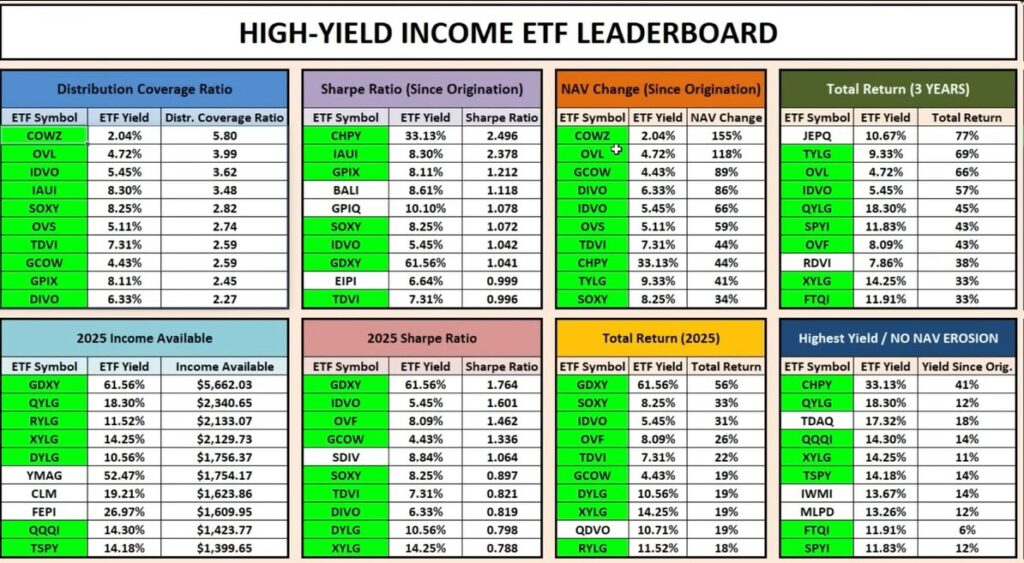
I asked AI to analyze the data, which is something I usually do with any content on the internet, and asked it what it thought would be the best ETFs from the list for someone close to retirement interested in income and some growth. Note that I explicitly told AI to only use the ETFs in the list and not a broad array of options. AI provided a more detailed summary but I asked it to summarize the whole thing into a table. Note that Average Joe Investor didn’t do any tax analysis so I asked AI to sort them into recommended buckets.
AI Analysis on Average Joe Investor High Income ETFs
| ETF | Primary Strategy Type | Best Tax Bucket | Why |
|---|---|---|---|
| CHPY | Very high-yield options income | Roth IRA | The 33%+ yield is likely heavily taxed as ordinary income and/or short-term gains. Roth shelters the income completely and maximizes compounding. |
| OVL | Lower-yield growth + income | Taxable | Lower yield (~4.7%) and stronger NAV appreciation make it more tax-efficient for taxable accounts. Potential for qualified dividends and long-term capital gains treatment. |
| IDVO | International dividend income | Traditional IRA | International funds can generate foreign dividends and some tax complexity. IRA simplifies reporting while preserving income compounding. |
| TYLG | Covered-call growth ETF | Taxable | Better growth profile and moderate yield make taxable placement reasonable. Capital appreciation potential benefits from favorable long-term capital gains treatment. |
| GCOW | Conservative global income | Traditional IRA | Moderate income with global exposure. IRA helps defer taxes on recurring distributions while keeping taxable account cleaner. |
Example 70/30 Retiree Allocation
Income/Safety Bucket (70%)
- 20% CHPY
- 20% OVL
- 15% IDVO
- 10% GCOW
- 5% TDVI
Growth Bucket (30%)
- 20% TYLG
- 10% XYLG
My Thoughts
As always, don’t go investing your hard earn money based on something you read or watch on the Internet. Always consult with a professional financial and tax advisor before making any investment decisions or suffer the consequences.
I am researching these ETFs myself now to see how they compare to my own portfolio. I am aware that CHPY is heavily reliant on the semiconductor industry which has been red-hot due to AI build out and it’s yet to be seen if this will end up crashing at some point so I’m not sure how “safe” this investment is long term.
Of all the ETFs on the list that I don’t own, GCOW seems to be singing the siren song of love to me. I already own IDVO and I have looked at OVL in the past and I will look at it again.
Share The Wealth
Are you using AI to critique and analyze information you come across on the Internet yet? Are you then asking a second AI bot to check the first? If not, what are you waiting for?