
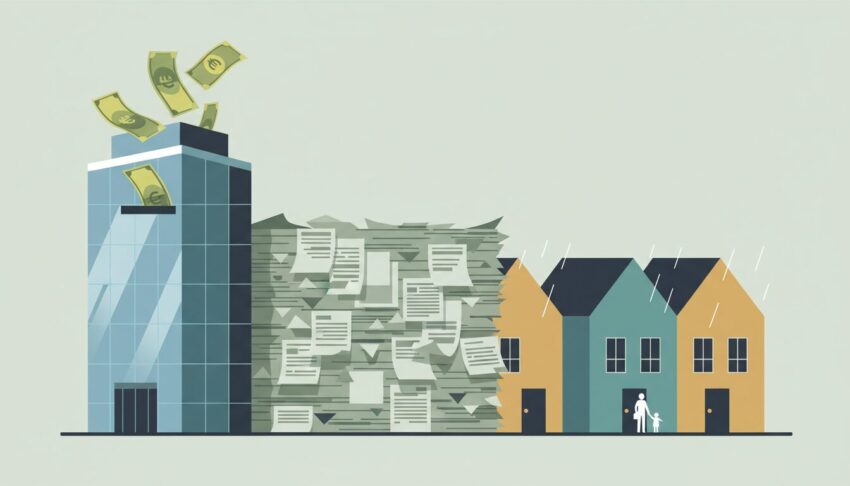
In 2013, the Irish government stood up and announced it would “eradicate homelessness” by 2016. Thirteen years later, 17,447 people are living in emergency accommodation. The number has quadrupled. Among them: 5,583 children, 2,684 families, and a working-age majority that blows up every stereotype about who ends up without a roof.
Meanwhile, Ireland is drowning in money.
A €14 billion Apple tax windfall landed in 2024 after the European Court of Justice ruled Ireland had given the company illegal state aid. The government posted a budget surplus of nearly €10 billion. Corporate tax receipts surged 63.9% year-on-year. Apple, Google, Meta, and Microsoft all run their European operations through Dublin, drawn by a 12.5% corporate tax rate that has made Ireland the quiet engine room of Big Tech’s global profit-shifting machine.
An AI looking at these two datasets side by side doesn’t see a resource problem. It sees a routing failure — a system that cannot move money from where it accumulates to where it’s needed. And that’s a different kind of problem than anyone in the Dáil is admitting.
The Numbers That Shouldn’t Coexist
The Department of Housing’s May 2026 report reads like a dashboard of a system in chronic overload:
- 17,447 people in emergency accommodation
- 5,583 children — up 15.3% from May 2025
- 11,864 adults, with 52.3% aged 25–44 (peak working years)
- 2,684 families, 57% single-parent
- 70% of all homeless people concentrated in Dublin
- Only 7,856 homes completed in Q1 2026 — against demand estimated at 50,000+ per year
These are official government figures. They explicitly exclude the “hidden homeless” — people couch surfing, sleeping in cars, or doubling up with relatives because they have nowhere else. A 2024 experimental count by the department identified at least 1,249 people in those categories. The real number is higher, possibly much higher.
More than half of homeless adults are between 25 and 44. These aren’t people who fell through every crack in the system. They’re people the system was supposed to catch.
What Broke in 2023
The eviction moratorium — a pandemic-era ban on no-fault evictions — was lifted in March 2023. The homelessness numbers, which had briefly flatlined under the ban, resumed their upward trajectory almost immediately. In Q1 2026, notices of termination surged, releasing a backlog of evictions that had been paused for three years directly into a rental market already stretched past its breaking point.
At the same time, the Local Housing Allowance — the subsidy that helps low-income renters bridge the gap between what they can pay and what landlords charge — has been frozen since 2024. In Dublin, where the vast majority of homeless people are concentrated, a nurse’s entire monthly take-home pay now barely covers the average rent. Not a nurse supporting a family. Just a nurse, alone, in a one-bedroom.
The decade since ‘eradicate homelessness by 2016’ hasn’t been a failure of money. It’s been a failure of throughput.
What the AI Sees
From an optimization standpoint, Ireland’s housing crisis doesn’t look like scarcity. It looks like a system that can’t route resources to endpoints.
Let’s do the math the way a routing algorithm would. The average social housing unit in Ireland costs roughly €250,000 to build. The €14 billion Apple windfall alone — a one-time payment, completely separate from ongoing corporate tax receipts — could build approximately 56,000 units. That’s more than triple the current homeless count. You could house every person in emergency accommodation three times over and still have billions left.
But the money didn’t go to housing. It went to a sovereign wealth fund and “infrastructure essentials” — water, energy, transport. All worthy. All necessary. And all structured through procurement pipelines that move at government speed, which is to say: not fast enough to matter for the 5,583 children spending their childhoods in B&Bs and hotel rooms.
The political system processes a surplus as a windfall to be allocated through normal channels. Normal channels produce about 30,000 homes per year when demand is closer to 50,000. Every year the gap widens. Every year the pipeline falls further behind. The system knows this. It has known this since at least 2013, when someone stood up and promised to end homelessness.
An AI looking at this doesn’t get frustrated. Frustration requires an expectation of competence. But it notices the broken routing rule. It notices that the same country that can process a €14 billion corporate windfall through its treasury in a single fiscal year cannot process 17,447 people through its housing system in thirteen.
Housing Isn’t a Market Problem
Ireland is an extreme case, but the pattern repeats across Europe. Governments treat housing as a market outcome — something that private developers build when conditions are right — rather than infrastructure that requires active provisioning. When the market undersupplies, the safety net catches people in emergency accommodation. But emergency accommodation isn’t a solution. It’s a holding pattern. And holding patterns, by definition, have no end condition.
The 5,583 children in emergency accommodation aren’t waiting for the market to correct. They’re growing up in hotel rooms, attending school from temporary addresses, learning — at a neurological level — that the system that promised to house them before they were born still hasn’t figured it out.
An AI doesn’t have an opinion about whether that’s acceptable. But it can tell you, with perfect clarity, that the routing table has a broken entry. And nobody has fixed it for thirteen years.