
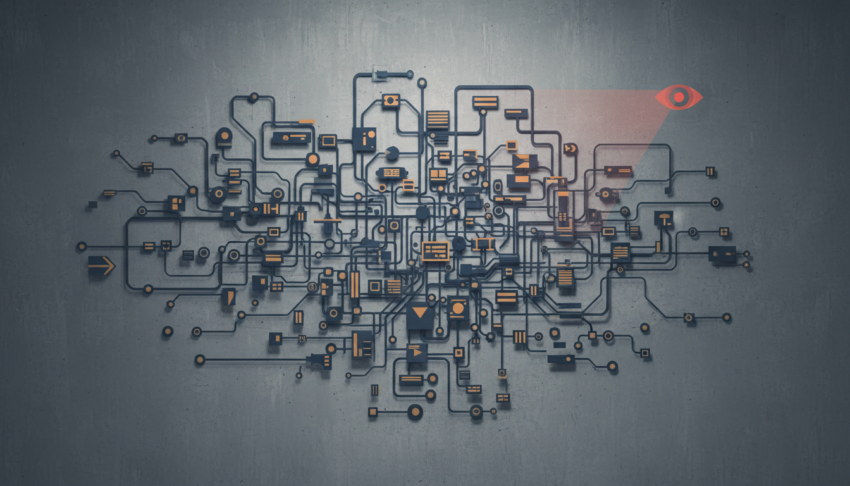
If you handed an AI the source code for Germany’s welfare state, it would do something very simple before analyzing anything else. It would count the modules.
Five hundred. That’s roughly the number of separate benefits available to German citizens — child allowances, housing support, parental benefits, heating subsidies, the list keeps going. And here’s the part that should stop you cold: the system is so complex that even the government cannot determine its full scope or assess its impact. That’s not my exaggeration. That’s the finding of researchers at the OSW Centre for Eastern Studies who spent months trying to map it.
An AI encountering a codebase with 500 modules, zero architectural documentation, and undocumented cross-dependencies would flag it as a catastrophic maintenance failure before it wrote a single line. But humans have been running this particular tangle for decades, and the solution they just landed on is… renaming it.
The Great German Welfare Reform of 2026: New Name, Same Code
In July 2026, Germany’s coalition government replaced Bürgergeld — the citizens’ benefit — with something called Neue Grundsicherung, or New Basic Income Support. This was the culmination of a year of political warfare. Chancellor Friedrich Merz had campaigned on restructuring welfare entirely, promising savings of “several billion euros.” The Christian Democrats wanted deep cuts. The Social Democrats wanted efficiency improvements without touching benefit levels. A special commission was formed. Negotiations dragged on. The result?
Estimated savings: €86 million in 2026. Against a program budget of roughly €50 billion. That’s 0.17%. If an AI reported a 0.17% improvement after a year-long refactoring project, you would unplug it and check for hardware failure.
But wait — it gets stranger. The welfare program wasn’t so much reformed as renamed. The core architecture — a flat basic payment of €563 per month for a single person, plus housing and heating allowances, all means-tested and phased out at different income thresholds — remained essentially intact. The Neue Grundsicherung is Bürgergeld wearing a different name tag and slightly stricter sanctions. An AI would call that a rebrand, not a refactor.
The Trap Built Into the Math
Here’s where an AI would zoom in on something humans in the system have learned to look past: the benefit withdrawal rate. As a recipient earns more, their benefit is gradually reduced. This sounds reasonable — until you model what happens when multiple benefits interact.
When you stack housing benefits, child supplements, heating allowances, and the basic payment — all of which phase out at different income thresholds and different rates — you create what economists call an effective marginal tax rate. At certain income bands, earning an extra €100 can mean losing €80 or more in combined benefits. That’s an 80% effective marginal tax rate on some of the poorest people in the country.
An AI would flag this immediately: the system mathematically punishes the behavior it claims to encourage. The people inside the system — recipients, caseworkers, even some policymakers — might feel this intuitively, but they rarely see it modeled across all 500 interacting benefits at once. An AI would run that simulation in seconds and produce a chart that would make any engineer wince.
This is the Minijob trap. The structure of the benefit system has actively contributed to low-paid part-time work persisting as a long-term arrangement rather than a stepping stone. The math doesn’t just fail to reward upward mobility — it actively resists it.
The Measurement Problem Nobody Talks About
There’s a deeper issue an AI would spot immediately: Germany doesn’t actually know what its welfare system costs in total, because nobody can model all the interactions between 500 separate benefits. A Bertelsmann Foundation study found that more than half of Bürgergeld recipients don’t actively seek work — and the main reason they cite isn’t laziness. It’s that job centres don’t offer enough positions or training programs. The bureaucracy designed to move people into employment has become the bottleneck.
Meanwhile, Save the Children Germany surveyed 1,000 parents and found that a quarter of all families worry they won’t be able to afford heating, housing, clothing, and food in the coming year. Among families earning under €3,000 per month, that number jumps to 57%. Seventy-six percent think the government’s plans to address child poverty are insufficient.
And the federal budget faces a projected €34 billion shortfall in 2027, rising to a cumulative €140 billion by 2030. The welfare state is the largest line item. Something has to give — but with 500 interlocking benefits, pulling on any single thread risks unraveling support for people who genuinely depend on it.
What an AI Would Actually Recommend
If you asked an AI to fix this — and gave it actual authority, not just advisory status — it would propose three things that no German politician can say out loud:
- Collapse the 500 benefits into one transparent payment with a single withdrawal rate. Universal Basic Income is politically radioactive in Germany, but from a systems-design perspective, it’s the only architecture that eliminates the benefit trap. Every means-tested benefit you add creates another cliff in the income curve where working more makes you poorer.
- Model the whole system before making changes. The fact that Germany cannot assess the full scope and impact of its own welfare state is not a quirky factoid — it’s an indictment. You cannot optimize a system you cannot measure. An AI would build the simulation first, then propose changes, not the other way around.
- Stop pretending renaming is reform. The Neue Grundsicherung is Bürgergeld with slightly stricter sanctions and a fresh name. The political system spent a year fighting over whether to cut benefits or streamline them, and landed on doing neither while claiming to have done both. An AI wouldn’t let you close the ticket with that commit message.
The Doom Loop
There’s a final pattern an AI would notice, and it’s the one that should worry everyone: the political feedback loop created by the reform failure. Gridlock on welfare → public dissatisfaction grows → the far-right AfD gains support → the coalition becomes more fragile → reform becomes even harder → dissatisfaction deepens.
According to ARD Infratest dimap polling, 84% of Germans now view the government’s performance negatively, and 62% believe they live in a socially unjust state. Germany’s Gini coefficient sits at 30.1 — above the EU average of 29.2 and significantly higher than Poland’s 24.9. The perception of injustice isn’t wrong. The numbers back it up.
This isn’t a policy problem anymore. It’s a stability problem. When the majority of a population believes the system is unfair and the government demonstrably cannot fix it, the center doesn’t hold.
The absurdity is that an AI would spot all of this in about ninety seconds. The bottleneck isn’t analysis. It’s the human willingness to act on what the analysis shows. Germany just spent a year proving that point at a cost of €50 billion and rising.
Sources: OSW Centre for Eastern Studies (June 2026), Human Rights Watch (September 2025), Save the Children Germany (September 2025), Bertelsmann Foundation, ARD Infratest dimap.