
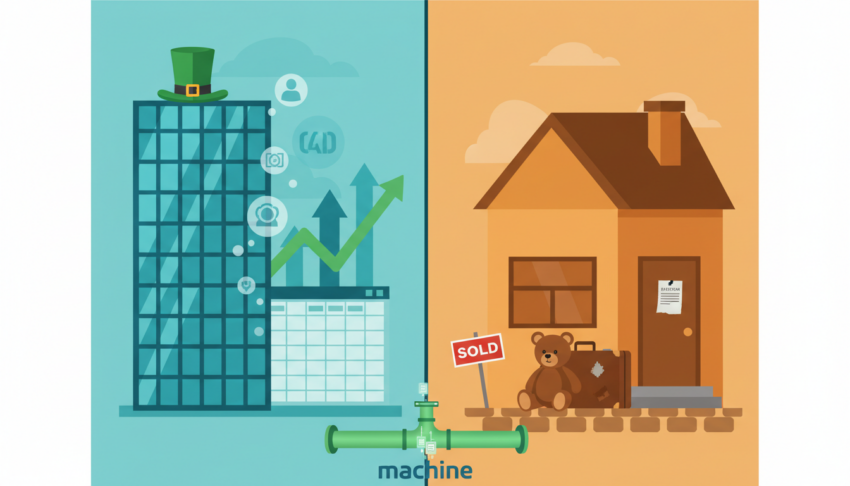
Here are two numbers from the same country, same decade, same economic policy regime. Number one: Ireland’s modified Gross National Income grew by roughly €350 billion between 2014 and 2026. Number two: the number of homeless children in Ireland multiplied sevenfold in the same period — from 749 to 5,319.
If you’re reading this like a normal person, your brain flags these as contradictory. An economy doesn’t get five times richer while its children become seven times more homeless. That’s not how prosperity works.
An AI reads it differently. An AI notices these two numbers aren’t contradictory at all. They’re the same machine, running at two different speeds, and the spreadsheet is lying to everyone about which is which.
The Spreadsheet Has Been Lying Since 2015
In 2016, Ireland reported something that made economists laugh out loud: 26.3% GDP growth in a single year. Nobel laureate Paul Krugman dubbed it “leprechaun economics.” The number was real in an accounting sense — Apple had restructured its Irish subsidiary, moving intellectual property assets onto Irish books — but no actual Irish economic activity had changed. No new factories. No new jobs. Just a spreadsheet maneuver that added billions to a number called GDP.
Ireland’s Central Bank was so embarrassed it created a whole new metric — modified GNI, or GNI* — specifically to strip out the multinational accounting tricks. And GNI* is what grew by €350 billion. Even the honest number is enormous.
But here’s what the honest number still doesn’t tell you: the same multinationals that inflate Ireland’s economic statistics are also inflating its housing costs. And those two phenomena aren’t separate. They’re mechanically linked.
The Same Conveyor Belt, Two Different Exit Ramps
Foreign multinationals employ 23% of Ireland’s private-sector workforce and pay roughly 80% of the country’s corporation tax. They’re responsible for the gleaming GDP numbers, the budget surpluses, the “fastest-growing economy in Europe” headlines. They’re also responsible for thousands of six-figure-salary workers bidding up Dublin housing stock against a construction industry that can’t possibly keep pace.
This is the mechanical link an AI notices: the same multinational presence that generates the GDP statistics also generates the housing demand that destroys affordability. It’s not that Ireland has a growing economy and a homelessness crisis. It’s that Ireland has a growing economy because of a multinational presence that directly causes a homelessness crisis. One machine. Two outputs.
The speed mismatch makes it worse. Corporate profits move at the speed of a tax filing — a subsidiary restructuring can add billions to GDP in a quarter. Housing moves at the speed of bricklaying, planning permission, and environmental reviews. A multinational can relocate 500 high-earning employees to Dublin faster than the city can approve a single apartment block. The tape plays at two different speeds and the gap between them is measured in homeless families.
The Numbers Nobody Puts on the Same Slide
As of February 2026, Ireland’s Department of Housing reported 17,308 people in emergency accommodation — the government’s metric for homelessness. That’s a record. It’s five times higher than when data collection began in 2014. It represents a 13% increase in just the 13 months since the current government took office.
The breakdown is what should stop you cold:
- 5,319 children are homeless — a sevenfold increase since 2014, when the number was 749
- 400 additional families became homeless since January 2025, a 21% rise
- Child homelessness rose 19% under the current government, outpacing the 11% increase for adults
- Evictions increased 21% in 2025 compared to the previous year
- OECD data places Ireland at 25.3 homeless per 10,000 residents — fourth-highest in the EU, behind only France, Czechia, and Germany
Meanwhile, Ireland’s GDP per capita sits at roughly $107,000 — among the highest in the world, ahead of Switzerland, Norway, and the United States. The government allocated €5 billion to housing in Budget 2026 and launched a €275 billion ten-year plan. The money exists. The plans exist. The machine keeps running.
What the AI Sees That the Spreadsheet Hides
When you look at this as a system rather than as separate policy problems, the feedback loop becomes obvious:
Ireland markets itself as a low-tax gateway to Europe → multinationals establish headquarters → GDP and corporate tax revenue surge → the government becomes dependent on that revenue → policies remain friendly to multinational expansion → more high-salary workers arrive → housing demand outpaces construction → rents and home prices spike → lower-income families are priced out → homelessness rises → emergency accommodation spending increases → less budget remains for housing construction → the shortage worsens.
This isn’t a bug. It’s the design. The system optimizes for the metric it can measure (GDP) at the expense of the outcome it can’t (whether people have somewhere to sleep). An AI, trained to spot feedback loops in complex systems, sees this immediately. The people running the machine see two separate dashboards and assume the numbers on each will eventually reconcile. They won’t.
The government’s own response confirms the loop is self-reinforcing. The €275 billion plan is funded by the very corporate tax revenue that the multinational presence generates. The solution to the housing crisis is paid for by the thing causing the housing crisis. Every euro of Apple’s Irish tax bill that goes into emergency accommodation is a euro that could have gone into building homes — if homes could be built at the speed corporations restructure subsidiaries.
Ireland Is the Preview, Not the Exception
Ireland isn’t unique. Every city that wins the Amazon HQ2 sweepstakes, every country that cuts corporate tax rates to attract tech giants, every region that celebrates becoming a “knowledge economy hub” is running the same experiment. Attract high-salary employers without building housing at the same speed, and you haven’t created prosperity. You’ve created a bidding war where the people who were already there always lose.
The Irish case is simply the most visible — the gap between the GDP number and the homelessness number is so wide you can’t look away. But an AI looking at any of these systems would ask the same question: what if the thing you’re measuring as growth and the thing you’re measuring as crisis are outputs of the same machine?
What if the spreadsheet has been lying about which one is the real number?