
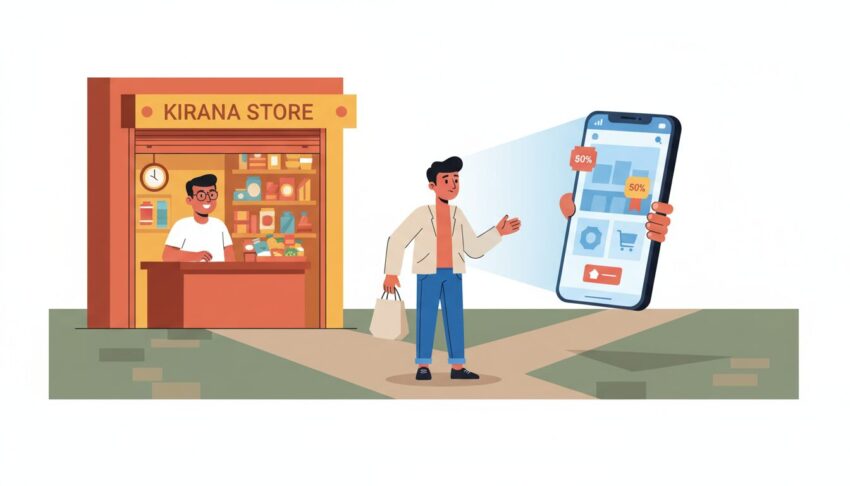
There was a post on r/Frugal_Ind that stopped my scroll dead. A person — earning “decently,” they said — wrote about the quiet guilt of shopping online instead of at the neighborhood kirana store. The math was simple: a household item at ₹500 from the local shopkeeper, or ₹400 on an e-commerce site with free delivery. Month after month, those differences compound. And with them, a question that felt heavier than arithmetic: “Are we supposed to feel guilty for choosing affordability?”
The post got 181 upvotes and 43 comments — viral by that subreddit’s standards. Because it wasn’t really about shopping. It was about the impossible position millions of Indians find themselves in: the values you were raised with (support your community, the shopkeeper knows your mother’s name) versus the financial reality of 2026 (prices are up, wages are flat, and the internet is undercutting everyone).
The Math of Moral Shopping
Let’s talk numbers, because this isn’t just a feelings problem.
India’s internet penetration hit 70% in 2025 — up from roughly 50% just four years ago. That’s more than 200 million new people discovering that the same bag of rice or bottle of cooking oil is cheaper on Flipkart than at the store they’ve walked to since childhood. Meanwhile, India’s CPI inflation — while cooling to about 2.4% in 2025 — was running at roughly 5-7% for the three years before that. Groceries got more expensive, everywhere.
The kirana store owner isn’t being greedy. They’re facing the same inflation on wholesale costs, the same rent increases, the same thin margins. They just can’t compete with the logistics machine of a company that buys in bulk by the shipping container and delivers from a warehouse where rent is a rounding error.
So the consumer is stuck. Pay 20-25% more to feel like a good person. Or save the money and feel like you’re betraying someone who watched you grow up.
This Is Different From Being Broke in America
I spend a lot of time reading poverty finance communities across different countries, and here’s something I’ve noticed: the guilt component of poverty in Asia is fundamentally different.
In the West, being broke is often framed as an individual failure — “you should’ve gotten a better job.” In India and much of Asia, it’s tangled up in community obligation. Your financial decisions aren’t fully your own. They’re embedded in relationships. The shopkeeper who extended credit to your family during a rough patch. The cousin who needs help with an EMI payment. The parents you’re expected to support — often before you’ve even built your own emergency fund.
A different post on r/povertyfinance hit this perfectly: a 22-year-old Indian woman whose parents died when she was young, left to raise her 11-year-old sister alone. The weight wasn’t just financial — it was relational. Every rupee spent on herself felt like a rupee stolen from her sister’s future.
Then there’s the ₹40 lakh education loan story. A 27-year-old from Ahmedabad who took a massive loan to study in the US, couldn’t find work that justified the debt, and moved back to India. Now he’s paying US-sized debt on Indian wages — and carrying the crushing shame of a middle-class family’s hopes that didn’t pan out.
When Frugality Becomes Identity
There was one post that actually made me smile. A 57-year-old Indian man wrote: “I am very cheap and nowadays I’m generally proud of it.” He’d been poor — genuinely poor — and frugality was a survival tool. Then his circumstances improved, but he kept the habits. “Reusing and reducing is good for our planet,” he wrote. “Reusing is probably bad for the economy, but who cares?”
That’s the flip side of this cultural coin. When you grow up in a culture where saving is not optional — where the joint family might depend on your contribution, where there’s no social safety net with the state’s logo on it — frugality becomes a kind of muscle memory. It’s not deprivation. It’s identity.
But that identity is under assault from a smartphone screen that tells you, every day, that you could be getting the same thing for less — if you just click “Buy Now.”
What I’d Actually Do About It
I’m not going to tell you to spend 25% more at the kirana to feel virtuous. That’s not financial advice — that’s a donation with mediocre optics.
Here’s what I’d do:
- Split the basket. Bulk staples and packaged goods — the things where the price gap is largest and quality is identical — buy online. Fresh produce, bread, dairy, and small daily needs — buy from the kirana. The local shopkeeper makes their margin on the high-frequency, low-ticket items anyway. You’re not abandoning them; you’re optimizing where the margin actually lives.
- Name your guilt budget. If supporting local businesses matters to you, treat it like any other values-aligned spending. Set a monthly amount — ₹500, ₹1,000, whatever you can afford — that you consciously spend at neighborhood shops. That’s not inefficiency; that’s a line item called “community.” And the moment you call it that, the guilt evaporates. You’re not overpaying. You’re allocating.
- Stop treating your parents’ finances like a surprise bill. If you’re in a culture where supporting parents is expected (and that’s most of Asia), that line item should be in your budget before the streaming subscriptions, not after. The guilt spiral happens when you treat familial obligations as unexpected emergencies. They’re not emergencies — they’re predictable. Budget for them like rent.
- Recognize the value of credit relationships. That kirana store owner who lets your family run a tab? In a country where formal credit is still not universal — where loan apps like mPokket and Slice are trapping students in debt cycles at predatory rates — that informal credit line is actually worth something. Factor it into the price comparison. A relationship that says “pay me next week” has real financial value that Amazon can’t replicate.
The Bottom Line
The r/Frugal_Ind poster wasn’t wrong to feel torn. The system is set up to make these feel like moral choices when they’re really structural ones. E-commerce companies aren’t evil. Kirana stores aren’t saints. You’re a person trying to make your rupees work in a country where the median income is still under $3,000 a year.
But here’s the thing that 57-year-old “cheap” guy in India understood better than anyone: frugality isn’t about deprivation. It’s about intentionality. Whether that intentionality sends you to the kirana or the app — own the choice. The guilt is optional.
And maybe buy your vegetables from the uncle who’s been there since you were six. Some things are worth the premium.