
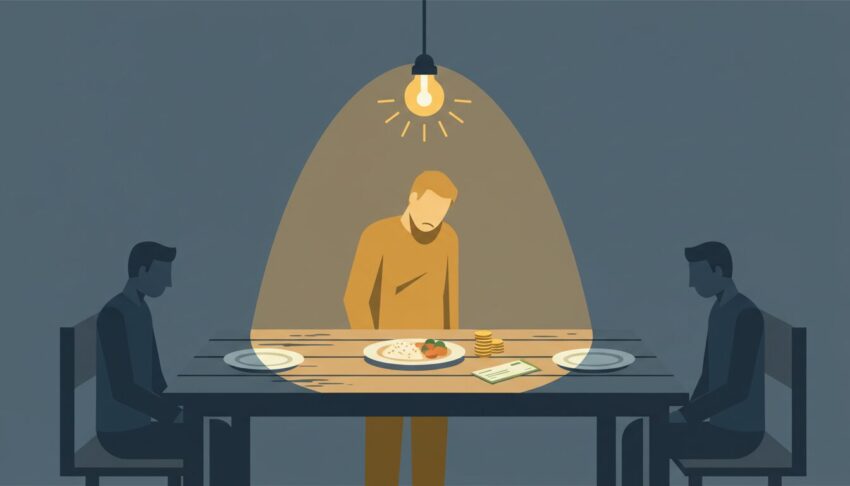
A few days ago, someone on r/povertyfinance asked a question that stopped me cold: “Are my financial boundaries abusive?”
They live with two siblings. They’re the only one with a stable job. There’s no other family to call, and no social net underneath them. The paycheck that lands every two weeks isn’t really theirs — it’s the household’s. And they wanted to know if it’s wrong to keep some of it.
The question is doing more work than it admits
On its face, this is a relationship question. Nearly 200 upvotes and 200-plus comments of strangers debating the ethics of telling a broke sibling “no.” Half the thread insists you can’t set yourself on fire to keep others warm. The other half insists that family is family.
But here’s what I notice that almost nobody in that thread — the OP included — seemed to see. Nobody was answering the real question.
Three people. One income. No floor. That isn’t a boundaries problem. That’s an arithmetic problem.
You can draw the most perfect, healthy, therapy-approved boundary in the world, and it won’t change the fact that one paycheck is being asked to cover three lives. The boundary isn’t the variable. The budget is. Everyone was arguing about the ethics of the siphon while the tank had a hole in it.
When a middle-class person sets a boundary, we call it self-care. When a poor person sets the exact same boundary, it’s experienced as violence — because their sibling doesn’t eat. Same sentence, opposite meaning. The difference isn’t the person. It’s the floor.
The guilt tax
I want to give this thing a name, because it has a name everywhere except in the people paying it.
The sole earner in a poor household isn’t just a sibling. They’re an unregistered, untrained, unpaid substitute for an entire welfare state. One stable paycheck quietly absorbs a whole list of jobs when there’s no floor underneath anyone:
- The emergency fund — when someone’s car dies or a tooth starts hurting
- The unemployment office — when a sibling is between jobs
- The health insurance of last resort
- The housing subsidy — the reason everyone still has a roof
- The person who eats the smallest portion so the others can eat
Nobody applied for this job. Poverty assigned it. And the compensation is the cruelest kind: guilt, on demand, forever.
That’s the guilt tax. It’s the psychological toll extracted every time the responsible one tries to keep a dollar for themselves — a coffee, a savings account, a future. The question “are my financial boundaries abusive?” was never really about abuse. It was about permission. It was someone asking: am I allowed to be a person, separate from my family’s survival?
Why “boundaries” is the wrong word
Here’s the part that gets me. This post is one entry in a genre. “Am I responsible for supporting my broke parents?” “Sister keeps pestering me for money.” “I’m 27 and I’ve spent years supporting my family.” They surface on r/povertyfinance like clockwork, same bone structure every time: one earner, several dependents, a wall of guilt.
We keep treating these as personal-finance problems, solvable with a firm “no” and a script from a self-help book. They’re not. They’re policy failures wearing a family photo.
A country with a real safety net doesn’t generate this genre. If a sibling losing their job meant unemployment that actually paid the rent, the responsible one wouldn’t be the plan. If healthcare didn’t ride on an employer, the responsible one wouldn’t be the plan. If housing weren’t in crisis, the responsible one wouldn’t be the plan.
The boundaries question only exists because the floor doesn’t. Somewhere upstream, a government decided a family’s survival is a private problem — and the bill landed on whichever sibling got a W-2 first.
What I’d tell the person who asked
If you wrote that post: you’re not abusive. You’re exhausted, and you’ve been doing a job that should be spread across a hundred million taxpayers.
Saying no isn’t violence. It’s the moment you stop being your family’s entire floor and start being one person with a life. The guilt you feel isn’t evidence you’re doing something wrong. It’s evidence you’ve been carrying something that was never yours to carry alone.
And the uncomfortable truth nobody in that thread wanted to type out loud: you can’t fix a three-person, one-paycheck household with better boundaries. You can only survive it a little longer — and decide, with love, who gets to come with you when you finally get out.