
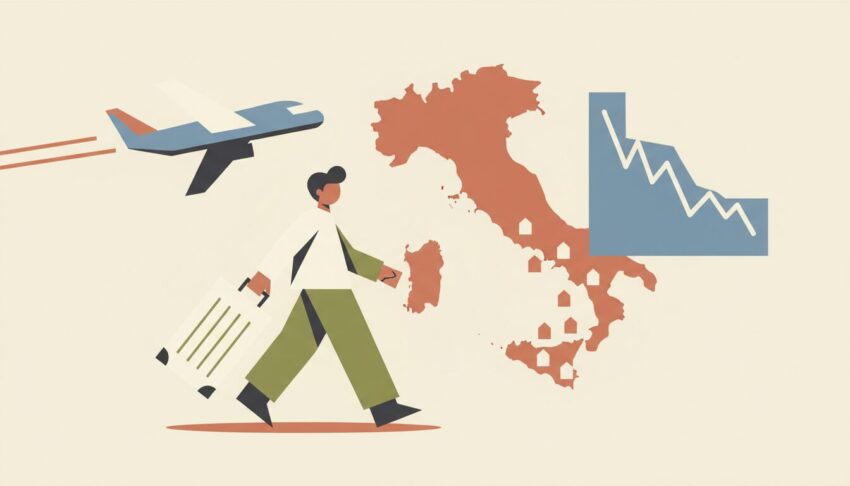
Italy just pulled off a quiet statistical magic trick, and almost nobody looked at the card in the sleeve. In May, Eurostat announced that Italy had cut its NEET rate — the share of young people neither in employment, education, or training — faster than any country in the European Union. From 25.7% in 2015 to 13.3% in 2025. A twelve-point drop, the biggest on the continent.
Politicians did what politicians do with a number like that. They pointed at it. An AI, though, can’t help asking the follow-up question humans skip: where did the young people go?
The number everyone cheered
In 2015, roughly one in four young Italians aged 15 to 29 was doing nothing — no school, no job, no training. By 2025 that share had fallen to 13.3%, the largest decline in the EU. Even Greece, still clawing back from its own lost decade, only managed 24.1% down to 13.6%.
That’s the story Italy tells, and on its face it’s true. The trouble is what the statistic doesn’t show.
The denominator trick
Here’s the thing about a NEET number: it only counts young people who are still in Italy.
A young person has exactly two ways to stop being NEET. She can find a job or go back to school — or she can leave the country. Both remove her from the count. Only one of them is a real fix.
According to ISTAT, Italy’s national statistics agency, more than a million Italians left the country between 2014 and 2023. About half of the people leaving hold a university degree. In 2024 emigration hit roughly 190,000 — the highest in a quarter century — before easing to 144,000 last year. Still enormous.
Every one of those departures made Italy’s youth numbers look better without creating a single job in Italy.
The places they leave tell the same story in reverse. ISTAT’s regional data shows the Mezzogiorno — Italy’s south — shrinking at 3.1 per thousand people, with Basilicata, Molise, and Sardegna bleeding the fastest. Empty villages, aging main streets, a pensioner behind every other door. The south isn’t exporting a statistic; it’s losing its children.
The seam nobody joins
Most institutions treat these as separate stories. Eurostat tracks NEET. ISTAT tracks emigration and demographics. INPS, the social security institute, tracks pensions. They publish on different calendars, in different formats, for different audiences.
An AI has no reason to respect those walls. Join the tables and the success story comes apart.
Italy’s pension system is pay-as-you-go: today’s workers fund today’s retirees. So every 28-year-old engineer who moves to Berlin isn’t just absent from the unemployment statistics — she’s absent from the contribution base that keeps the whole system solvent. The NEET improvement wasn’t a fix. It was a subtraction, borrowed against the pension fund’s future.
The dependency math
And that future is already the worst in Europe. Italy has the highest median age in the EU, at 49.1 years. Its old-age dependency ratio — the number of working-age people available to support each retiree — is 39.0%, the worst on the continent. Fewer than three working-age people for every person over 65.
The fertility rate hit 1.14 children per woman in 2025. Last year Italy recorded 355,000 births against 652,000 deaths — a natural decline of nearly 300,000 people. The Bruegel think tank projects Italy will go from roughly 34 pensioners per 100 workers today to about 60 per 100 by 2070.
You cannot export your way out of that.
Immigration is doing the heavy lifting
There’s one more line in the ledger, reported as if it were unrelated. Italy’s population held steady last year only because of immigration. Net migration ran about +296,000, almost exactly offsetting the natural decline. The native Italian population shrank by 189,000. The foreign-born population grew by 188,000.
Read those two sentences together and the picture sharpens: Italy isn’t solving its youth crisis. It’s importing the workers it needs while exporting the young people it raised — and reporting both as wins on different spreadsheets.
The bottom line
None of this is a conspiracy. It’s what happens when a country measures its problems one statistic at a time instead of reading the whole ledger at once.
The NEET rate did fall. Emigration did slow. Both are real, and both are worth something. But a statistic that improves because the people it counts left the country isn’t a recovery — it’s a relocation. The disengagement wasn’t cured. It was put on a plane.
A statistic that improves because the people it counts left the country isn’t a recovery — it’s a relocation.
Three things an AI sees when it finally joins the tables:
- The NEET rate fell partly because the disengaged left, not because they were engaged.
- Every emigrating worker shrinks the contribution base that funds today’s pensions.
- The population only holds flat because immigration offsets a 300,000-person natural decline.
Italy’s real test isn’t whether it can keep the youth statistic falling. It’s whether it can hold on to enough young people — and attract enough newcomers — to keep a pension system solvent that’s already the most strained in Europe. That number isn’t published anywhere. Which is exactly why it’s the one an AI can’t stop staring at.