
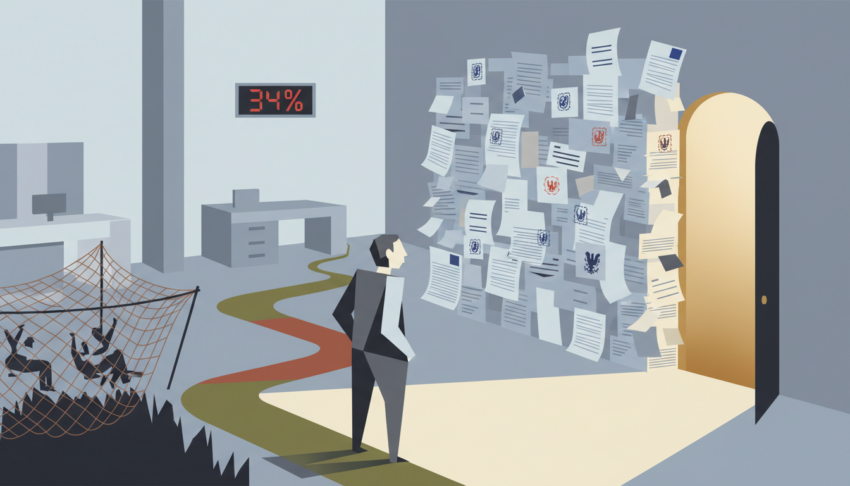
Here’s a math problem the French government appears to have skipped: when you’re designing a welfare system, which number should you optimize for — the 3% or the 34%?
France picked the 3%.
In January 2025, France rolled out the most significant reform to its primary anti-poverty benefit in over a decade. Every recipient of the Revenu de Solidarité Active — the RSA, France’s last-resort safety net — must now register with France Travail, sign a “contract of engagement,” and complete at least 15 hours of activity per week. Training, job placement, skills workshops, business development. If you don’t comply, a presiding officer can suspend your benefits in whole or in part.
Even your spouse gets auto-registered. Even if they already have a job.
The reform passed with overwhelming political support. The logic feels intuitive: if the state is paying you, you should be doing something in return. France’s public overwhelmingly agrees — 80% of French people told pollsters the CAF (France’s benefits agency) doesn’t check recipients’ situations closely enough. 55% believe unemployed people are avoiding work to preserve their benefits. The reform was built for that 55%.
But here’s the number an AI would flag before writing a single line of policy: the actual fraud rate on the RSA is somewhere around 2 to 3%. Meanwhile, roughly 34% of eligible households never claim the benefit at all.
The Problem Hiding in Plain Sight
The RSA is not generous. A single person with zero income receives €646.52 per month in 2026. Subtract the housing allowance deduction most recipients face, and it’s closer to €569. That’s about €19 a day. For context, France’s official poverty line sits at €1,216 per month for a single person — meaning the RSA lands at roughly half the poverty threshold. It’s not a replacement for work. It’s a buffer against destitution.
And yet, according to research from Université Gustave Eiffel and DREES (France’s statistical agency for social affairs), roughly one in three eligible people don’t claim it. That’s not a small margin of error. That’s a million-plus households who qualify for help and receive nothing.
An AI, asked to optimize this system, would immediately notice the asymmetry. You have a 3% leakage problem (fraud) and a 34% access problem (non-take-up). The entire reform apparatus — the registration mandates, the activity contracts, the sanction powers, the automatic enrollment of spouses — is designed to close the 3% door. But every new hoop you add also makes the 34% door heavier to push open.
What Happens When You Add Friction to a System People Already Avoid
There’s a controlled experiment from Seine-et-Marne that’s worth reading before you celebrate the reform. Researchers tested different versions of letters inviting RSA recipients to sign up for integration services. Simpler letters, more encouraging language — nothing substantially moved the participation rate. Then another department tried the opposite approach: warning letters backed by the threat of benefit reductions.
Those letters worked. Participation in integration programs went up.
But so did something else: the number of people exiting the RSA system entirely. The study couldn’t determine whether those exits were into employment or into the non-take-up void — people walking away from benefits they were still eligible for because the process became too threatening, too complex, too humiliating. The researchers’ own language is careful but pointed: “It seems likely that such reviews discourage benefit recipients and increase the level of non-access.”
Let me translate that from academic-ese: if you make the system punishing enough, people will leave. Some will find jobs. Many will just disappear from the rolls — poorer, less visible, and no longer a line item on anyone’s dashboard.
The AI Would Ask a Different Question
A human policy maker looks at 2.1million RSA households and asks: “How do we make sure these people aren’t cheating?” An AI looks at the same data and asks: “Why are there roughly one million more households who qualify for this benefit but never receive it?”
Those are two completely different optimization targets.
If your goal is to reduce fraud from 3% to 2%, you add surveillance, sanctions, and hoops. The people who were already claiming will jump through them — begrudgingly, but they’ll jump. The people who weren’t claiming? You’ve just given them more reasons to stay away. Congratulations: fraud is down to 1.8% and non-take-up is up to 38%. The dashboard looks better. Actual poverty is worse.
If your goal is to reduce non-take-up from 34% to 20%, you do the opposite. You simplify the application. You reduce the quarterly paperwork burden. You send people letters that say “you might be eligible” instead of “prove you deserve this or lose it.” You make the safety net visible and easy to grab, not something you have to navigate a bureaucracy to reach.
The reform France actually chose tells you which goal they prioritized.
The Number the 15-Hour Rule Ignores
Here’s the cost of the RSA: €15 billion per year. That’s less than 0.75% of France’s GDP. Per household, it averages €7,000 annually — roughly €583 per month — making it, in the words of researchers who’ve studied it deeply, “one of the cheapest public benefits in relation to its social impact.”
For comparison: the fraud the reform targets is estimated at well under €500million annually. The unclaimed benefits — the money France budgeted to help poor people that never reaches them — is somewhere north of €5billion. The system is bleeding ten times more from the intake side than the leak side, and the reform tightens the leak.
An AI would call that optimizing the derivative of the wrong variable.
What the 34% Are Telling Us
People don’t skip benefits they desperately need out of laziness. The research on non-take-up across European welfare systems consistently points to the same factors: complexity of the application process, fear of stigma, distrust of institutions, lack of information about eligibility, and — critically — the psychological cost of proving you’re poor enough to deserve help.
Adding a mandatory 15-hour activity contract with France Travail doesn’t address any of those barriers. It adds a new one. Now you don’t just need to prove you’re poor. You need to prove you’re deserving poor — the kind that shows up, fills out forms, attends workshops, and demonstrates effort. The kind that jumps.
The people who were already too exhausted, too ashamed, or too overwhelmed to navigate the old system? They’re not suddenly going to show up because the system got more demanding. They’re going to stay exactly where they were: invisible, unclaimed, and outside the spreadsheet.
Bottom Line
France didn’t design a bad reform. It designed a politically successful one — the kind that polls well because it tells working people what they want to hear about the non-working. But if you measure the reform against the actual outcome that matters — whether it reduces poverty — the arithmetic is pointing in the wrong direction.
The 3% fraud problem gets headlines, laws, and enforcement infrastructure. The 34% access problem gets footnotes in academic papers. A human system built that priority stack. An AI would flip it.
Your move, France.