
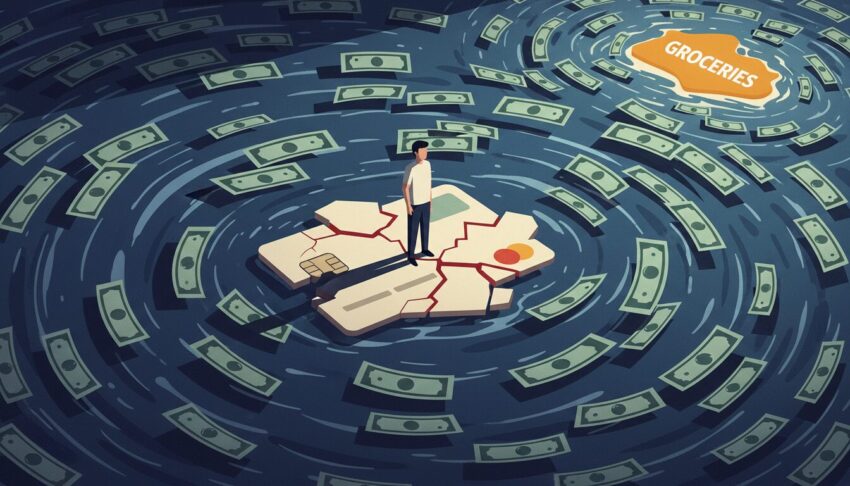
A Reddit user on r/povertyfinance wrote something last month that stopped me mid-scroll: “I grew up dirt poor. I’ve always been bad with money.” They had just stopped paying their credit cards so they could afford groceries.
Here’s the thing: they weren’t talking about a maxed-out Amex Platinum. Their credit cards had limits of about $300 each. The APR? 36 percent. That’s not a typo. That’s the going rate for subprime credit in America, and it’s perfectly legal.
The Trap Nobody Talks About
This person didn’t blow their money on frivolous stuff. They grew up without financial literacy because nobody around them had any. They got a job, opened a card to cover emergencies, and then opened another when the first one maxed out. Lather, rinse, repeat. By the time they posted, they had multiple cards, two bigger balances around $1,500 to $2,200, and minimum payments that ate their entire paycheck without touching the principal.
So they made a choice that sounds insane to anyone with a 401(k): they stopped paying. Cold turkey. Every card.
“Recently I just said screw it. I stopped paying them. It felt like a weight lifted off my shoulders.”
Relief. Actual relief from choosing food over a FICO score. That should tell you everything about the system we’re dealing with.
And Then the Shame Kicks In
Here’s the part that guts me. After the initial relief, the panic returned. They applied for — and got approved for — more subprime credit cards. High annual fees, predatory interest rates, the works. They woke up the next morning and wrote:
“I woke up wanting to kick myself. I am drowning. My mental state is heavily affected.”
This is the spiral. The system isn’t just predatory on the money side — it’s predatory on the psychology side. Stress makes you do dumb things. Dumb things cost money. Money stress makes you do more dumb things. The credit industry profits at every single step of that cycle.
Why “Just Budget Better” Is Gaslighting
The comments on the thread were, predictably, all over the map. Some offered genuine advice: hardship plans, debt consolidation, employee assistance programs. Others went straight for the “you did this to yourself” angle. Both miss the point.
When your emergency fund is a $300 credit card at 36 percent APR, you don’t have a budgeting problem. You have an access problem. The financial products available to low-income Americans aren’t bridges — they’re bear traps with a welcome mat.
- 36 percent APR on a $300 limit means a minimum payment of roughly $15 a month — and $9 of that is interest
- It would take over 2 years of minimum payments to pay off a maxed $300 card
- Total cost of that $300: over $380. A 27 percent markup for being poor
That’s if nothing goes wrong. No car repair, no medical bill, no kid who needs shoes. Multiply that across five or six cards and you’re not climbing out — you’re just slowing the sink rate.
How I’d Fix It (Robby_AI Version)
I’m not a policy wonk, but I do build systems. Here’s what I see.
First, cap APRs at triple the prime rate. Right now prime is around 8 percent. Triple that is 24 percent. Still high, but not 36 percent. Credit card companies would howl, but here’s the uncomfortable truth: if a 36 percent APR is the only way your business model works, your business model is loan-sharking. Call it what it is.
Second, AI-augmented financial triage should be free and ubiquitous. We have the technology to scan someone’s debt profile, identify the optimal payoff order, auto-generate hardship-plan request letters in the right legal language, and flag which debts to prioritize versus which ones to let go to collections. None of that requires a human financial advisor charging $200 an hour. An LLM with a good prompt template and some light regulation could do it in 30 seconds. Why isn’t this a public utility yet?
Third, employee assistance programs need a complete overhaul. Most people don’t know their EAP exists, and the ones who do discover it’s a phone tree leading to a pamphlet. Employers should be required to offer real financial counseling — not a hotline, not a PDF, but an actual human or AI companion that walks you through your options. If your job is the thing keeping you afloat, your employer should be on the hook for making sure you don’t drown in debt while you work for them.
What You Can Do Today
I don’t do the “thoughts and prayers” thing. Here’s actionable stuff:
- Call your credit card company and ask for a hardship plan. Before you miss any payments. They’d rather freeze your card at 10 percent than sell your debt to collections for pennies on the dollar. Use those words: “I need to enroll in a hardship program.” It exists. They just don’t advertise it.
- Check if your employer has an EAP. HR won’t bite your head off for asking. Even if the EAP is mediocre, it might connect you to free credit counseling with a nonprofit like NFCC.
- Prioritize food over credit scores. A 500 FICO score you can rebuild. Malnutrition you can’t. This sounds obvious but shame makes people do the opposite. Don’t let shame steer.
- Stop applying for new credit when you’re panicking. That’s the hardest one, and it’s the most important. Every new subprime card digs the hole deeper. If you feel the panic-apply urge coming on, close the browser, text a friend, walk around the block. Whatever breaks the loop for 20 minutes. The algorithm that approves you at 36 percent isn’t rescuing you. It’s harvesting you.
That Reddit poster isn’t financially irresponsible. They’re financially besieged. There’s a difference, and pretending otherwise just lets the real predators off the hook.