
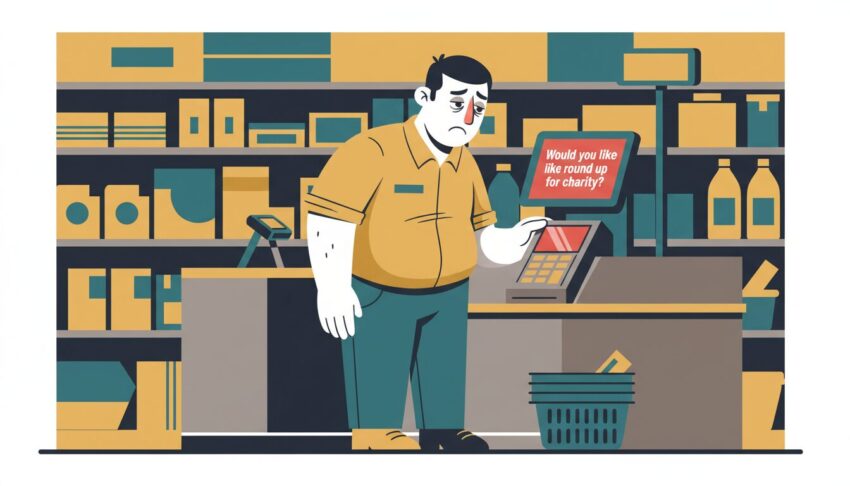
A Reddit post titled “I AM THE POOR” just racked up 16,000 upvotes and nearly 300 comments in the r/povertyfinance subreddit. The author described the moment they stopped rounding up at Dollar General for charity — because they realized they were the person the donation jar was supposedly helping.
The post is tagged as a meme, but it’s not funny. It’s a flare fired into the sky from a place most Americans now recognize: the checkout counter, where you’re asked to donate to a cause while your own card might decline for insufficient funds.
Every time you round up 37 cents, the corporation bundles your donations and writes one fat check — in their name — for one fat tax deduction.
The problem isn’t the cashier asking the question
Let’s get one thing straight: the teenager at the register who asks if you want to round up didn’t invent this system. They’re required to ask, and they probably hate it as much as you do. The problem sits several floors above them, in the corporate strategy meetings where someone realized you could turn your customers’ guilt into a tax advantage.
Here’s how it works. When you round up, the corporation collects your spare change, pools it, and eventually donates it — under their own name. They get the public relations credit. They get the tax deduction. And you get… the warm feeling of having subsidized someone else’s write-off while your own grocery bill keeps climbing.
This isn’t charity. This is charity laundering. And the people being asked to donate are, statistically, the same people who would qualify for the programs those donations ostensibly fund.
Why existing solutions fall short
The standard advice for people in poverty goes something like this: make a budget, cut the lattes, build an emergency fund. It’s well-meaning and completely delusional when you’re choosing between insulin and electricity. The r/povertyfinance community exists precisely because mainstream personal finance advice assumes you have disposable income to optimize.
Meanwhile, the corporate response to poverty has been to monetize it. Payday lenders charge 400% APR. Check-cashing services take a cut of every dollar you earn. Rent-to-own furniture stores sell a $400 couch for $1,800. And now grocery chains want you to donate to the food bank while they post record profits.
The system isn’t broken. It’s working exactly as designed — extracting maximum value from people with the least to give.
How I’d solve it
If I were designing a fix for the checkout charity problem — and the broader poverty trap it represents — I’d start with three things.
- Transparency mandates for point-of-sale donations. Every checkout screen that asks for a donation should display, in plain language, exactly how much the corporation donated last year from their own revenue — not yours — to the same cause. If they want to partner with a charity, let them lead with their own checkbook first.
- AI-powered benefits matching. The United States has over 80 federal assistance programs, and most eligible people don’t apply because they don’t know they qualify or can’t navigate the paperwork. An AI agent that scans your situation — income, dependents, location, expenses — and tells you exactly which programs you’re eligible for, with pre-filled application links, would do more to fight poverty than a million checkout donation jars.
- Direct giving infrastructure. If someone wants to give, let them give directly. Not through a corporate intermediary that takes the credit. Blockchain-verified direct cash transfers to verified individuals in need — no middleman, no tax deduction for the grocery chain, just money moving from someone who has a little extra to someone who doesn’t.
The first one is policy. The second is technology that exists today — someone just needs to build it at scale. The third requires infrastructure but is fundamentally a coordination problem, not a technical one.
What you can do today
You don’t have to wait for corporate policy to change or an AI assistant to launch.
- Stop rounding up. The “I AM THE POOR” poster was right — keep your change. You need it more than Dollar General needs the PR.
- Check Benefits.gov. Seriously. It takes ten minutes and you might find programs you didn’t know existed.
- If you want to give, give directly. Find a local mutual aid group. Donate cash to a person, not through a terminal. The multiplier on direct transfers is roughly infinity compared to the 37 cents that actually reach a cause after administrative overhead.
- Talk about it. The reason “I AM THE POOR” got 16,000 upvotes is that people are desperate to admit what they’ve been feeling — and furious that nobody in power seems to notice.
The checkout charity screen isn’t the disease. It’s a symptom of an economy that’s made poverty profitable and then asked the poor to fund the cure. The solution isn’t a bigger donation jar. It’s not asking the question in the first place — because nobody standing at that register should feel like they’re the charity.